Customers Look For Savings as They Switch from Petrol and Diesel
With the recent rises in fuel costs for the first half of the year, customers have been switching to hybrids, plug-in hybrids and electric cars in greater numbers, as they shy away from traditionally fuelled vehicles, according to SMMT data.
And the car industry looks to be showing other green shoots with June 2026 data reflecting the new car market rises 11.4%, accounting for 213,166 units, which the SMMT says is its best performance for the month since 2019.
But what is evident now is that that the inflection point is near, because electrified vehicles combined (electric, hybrid and plug-in hybrid) now account for the majority market share at 56.5% of new car registrations. And, it won’t be long before battery electric cars take number one slot in market share if the current trends continue, which is exactly what the ZEV mandate is intended for.
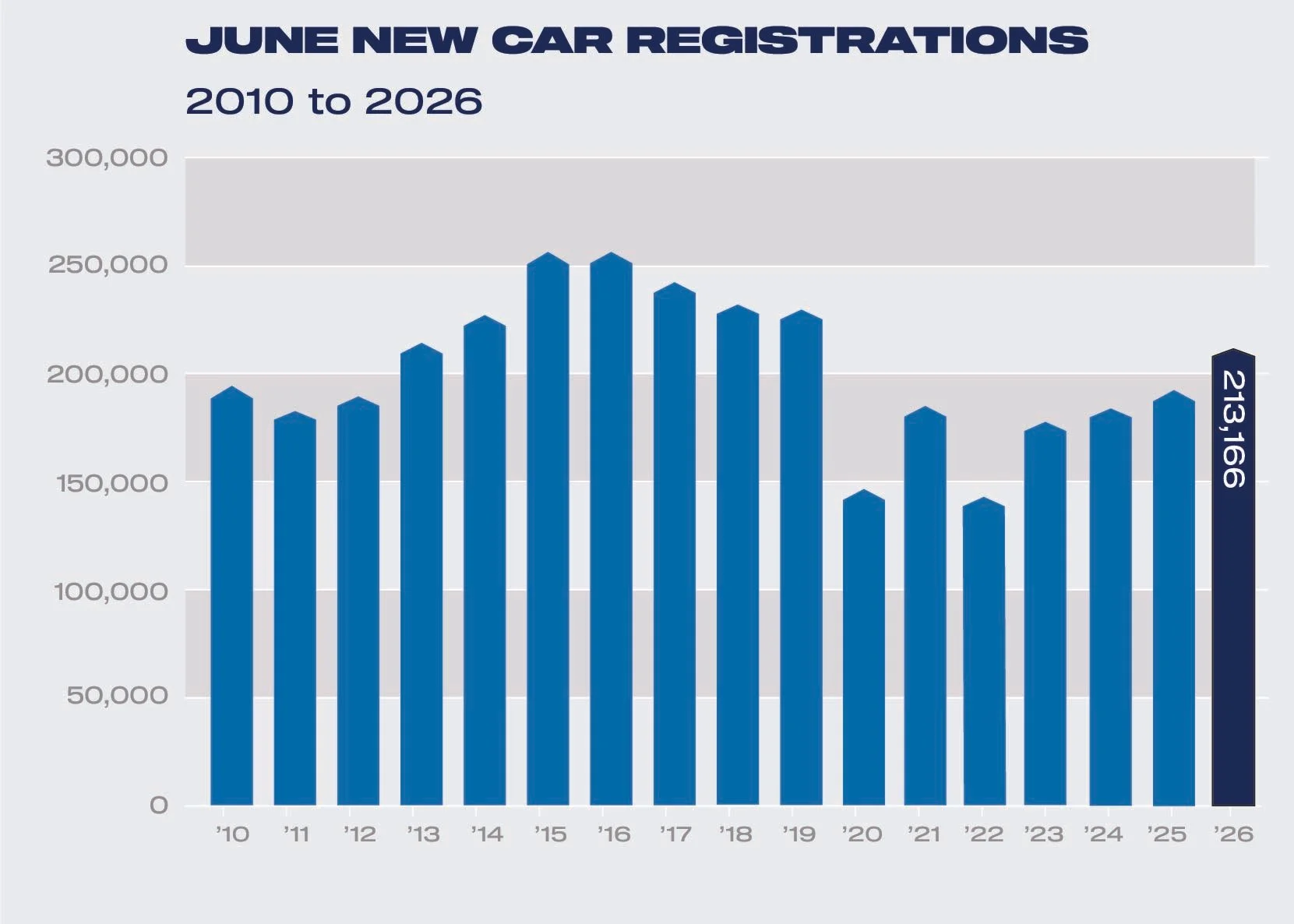
SMMT reports best June Since 2019
Winners
Surging ahead are battery electric cars with very impressive growth of 35% compared with June 2025, taking up a huge 30% market share of new car registrations.
Hybrid Electric Vehicles registrations grew 25.3% in June, taking 14% market share, with plug-in hybrids following closely behind with a surge in registrations of 24.9% accounting for a 12.5% market share.
However, it’s not all rosey for electric cars despite the huge swings in recent months, because the ZEV Mandate target for EV market share is set at 33% for 2026, and the numbers still lag at 25% market share when looking at year-to-date numbers, following a flat January and February.
With the added flexibilities, this brings the target percentage down, but the SMMT are calling on the U.K. government to make changes as the aggressive targets set some years ago may not be met this year, and that will hurt European manufacturers at a time when they’re already hurting with declining sales and rising costs.
Losers
There are three momentus points to discuss here:
Diesel registrations collapse 24.4% compared to June 2025, partly because manufacturers are shying away from making diesel engines compliant with EU regulations, but also because these last 6 months have shown diesel fuel costs surging to near £2 per litre, meaning a tank of derv for some was hitting them with an eye watering £114 for a 60 litre fill up.
Diesel registrations now fall below the 4% market share threshold, for the first time taking just 3.8% of the market. Diesel could now be considered a niche fuel for new car sales.
Petrol registrations fell 4% year-on-year in June 2026, with a market share now below 40% for the first time, at 39.7%.
The shift in sentiment reflects cost saving opportunities where petrol and diesel vehicle refuelling costs surged in the first half of the year, and customers, as well as business, are looking to capitalise on the greater efficiency and lower running cost of electrified vehicles.
To put those percentages into perspective, petrol vehicle registration numbers stood at 84,541 units, with battery electric vehicle registrations at 63,950 units. In contrast, diesel numbers fell to 8,099 units in June 2026.
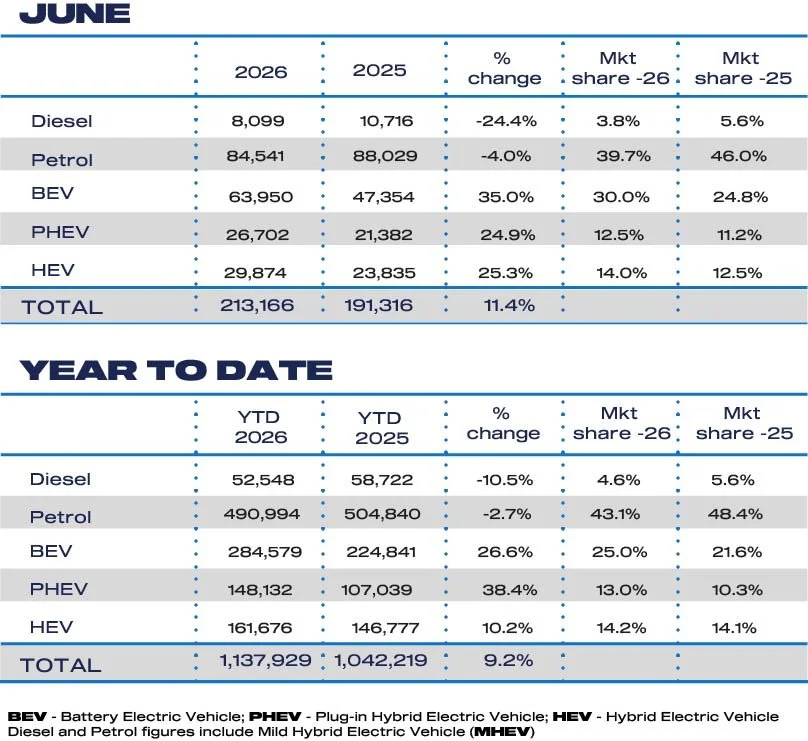
SMMT Year-on Year and Year-to-Date Car Registrations
June Registrations by Sales
Despite volumes increasing, the mix of buyers (by type) has stayed fairly static.
Private buyers account for 37.8% of market share, up from 37.4% a year ago taking 80,671 units, and growing 12.5% compared to 2025. However, in 2026 alone, private sales have reached nearly 40% market share at 39.9%.
Fleet are the largest consumer at 59.5% market share, down half a percentage point compared to 2025, which - despite the small change in percentage - reflects a decline of 10.5% year-on-year.
Year-to-date number shows a bigger decline with market share falling to 58.0%, down from 59.2%.
Business registrations grew 0.2% to 2,7% market share, but that reflects a 17.1% rise year-on-year, but year-to-date numbers remain static with just a 0.1% increase in 2026.
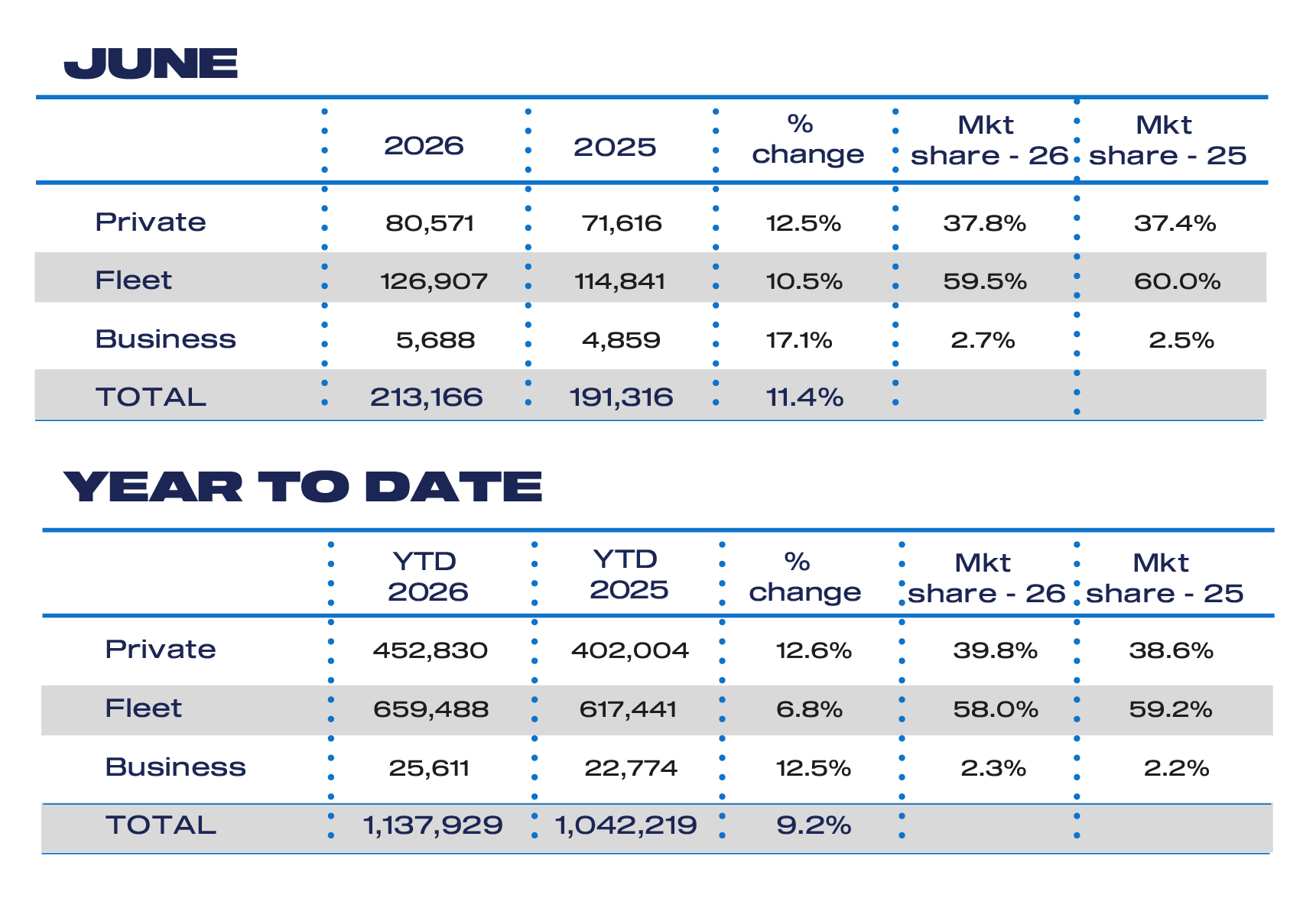
SMMT data for Car Registrations by Sales Type
Mike Hawes, SMMT Chief Executive says “June’s performance is very strong, showing EV uptake is growing, with battery electric cars reaching their highest market share this year and more than half of buyers choosing electrified models. But even these record levels are still not enough to meet mandated targets. Manufacturers are investing billions developing and bringing the vehicles to market – and spending billions more to sell them, yet the market is still not moving fast enough. Reforming the mandate now is essential not just to keep the transition on track but to protect the UK’s competitiveness, attract investment and safeguard jobs”.
Best Selling Models
June 2026 data reveals some big swings in top sellers, and this is largely due to the manufacturers deals Tesla has recently had that has attracted more buyers to the brand.
Year-on-Year
The Model Y takes number 1 spot in June 2026 with 6.765 units, and the Model 3 takes second place with 5,408 units.
Closely followed in third pace is the Ford Puma, with 5,248 units with a mix of petrol, mild hybrid and electric powertrains, and is a car that often takes the top spot in the sales charts. Kia Sportage and Nissan Qashqai (two regular top five cars) take 4th and 5th position respectively.
Former top spot holder, is the Jaecoo 7 featuring in seventh place, a remarkable achievement considering it hasn’t been on sale for a year yet.
Year-to-Date
The Ford Puma shows that it’s a solid performer taking the top spot in the charts, with the Kia Sportage in a clear second place. But it’s the Jaecoo 7 that’s making remarkable progress winning favour with many households looking to grab a compelling mid-sized SUV.
And thanks to that bumper month, The Tesla Model Y now features in the top 10 in tenth place selling 15,341 units so far this year.
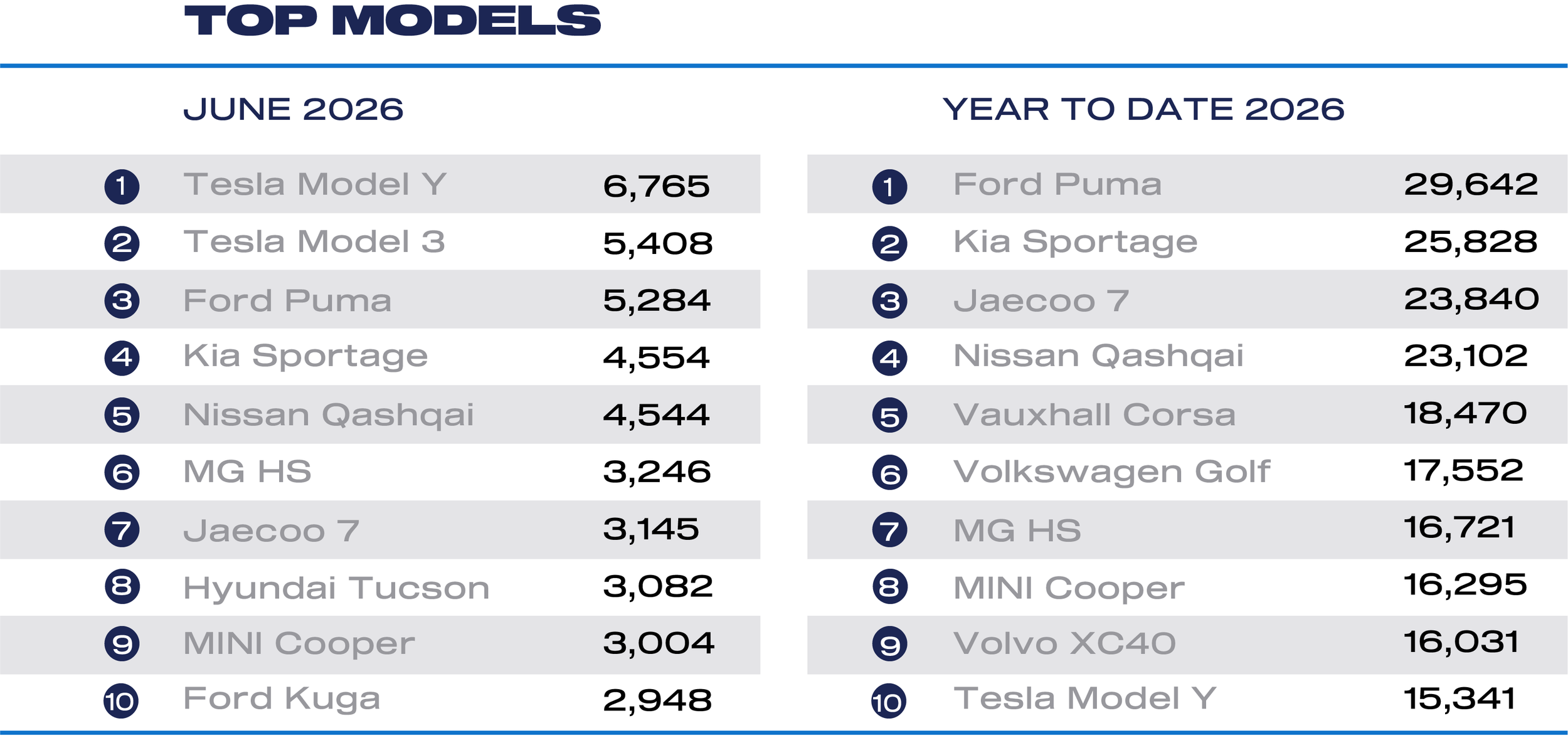
SMMT Best Sellers June 2026 and Year-to-Date
What is evident is a changing sentiment towards electric cars and electrified cars. The conflict in the Middle East has highlighted the volatility that traditional fuels are subject to when supply becomes constrained. Yet, the same cost increase is marginal for electric cars on an electric car focused tariff, because the difference of a penny or two per kWh translates to a few pound a year extra to fuel it.
Big swings in the price of petrol or diesel put the additional costs of fuel up by hundreds per month for some, and it’s simply difficult to absorb a shock like that.
———
About the Author
Graeme Cobb is a lifelong car enthusiast with a passion for writing about cars, EVs, industry updates and more.
You can find Graeme on 𝕏 at @graeme_cobb