Bi-Directional charging refers to electrons that can flow to the car or from the car, but not be consumed by the car.
When an electric car, or plug-in hybrid car is charged, the electrons flow from the source energy, through the charger (which communicated with the car) and into the cars high voltage traction battery, charging it up.
Bi-Directional charging allows the flow of electrons from the cars high voltage traction battery - and this is where it gets interesting - using that stored electricity to power tools, recharge batteries, or even run a coffee machine, or a house, for example.
As more cars feature bi-directional charging, its worth looking at the various different types to become familiar with its capabilities.
Here we breakdown the various types of bi-directional charging.
Vehicle-to-Grid (V2G): Allows EVs to feed stored energy back to the national grid during peak demand to maintain grid stability and potentially earn revenue.
Requires a compatible home bi-directional charger.Vehicle-to-Home (V2H): Enables an EV to act as a home energy storage system, supplying power to the whole house during power outages or high-cost energy periods.
Requires a compatible home bi-directional charger.Vehicle-to-Load (V2L): Uses the car battery to power external devices, tools, or appliances directly, usually via an adapter, without needing a special, expensive wall charger. Must read the maximum load first, which could be limited to a 2, 3 or 5 kW power draw, for example.
Requires an adapter that plugs into the charge port on the car.Vehicle-to-Building (V2B): Similar to V2H, but on a larger scale, allowing parked vehicles to power commercial properties or office buildings.
Requires compatible bi-directional chargers.Vehicle-to-Vehicle (V2V): Enables one EV to directly charge another EV, providing a potential emergency solution to alleviate range anxiety - great for the recovery services when EVs run out of charge.
Can use the V2L adapter or a specialised male-to-male cable.
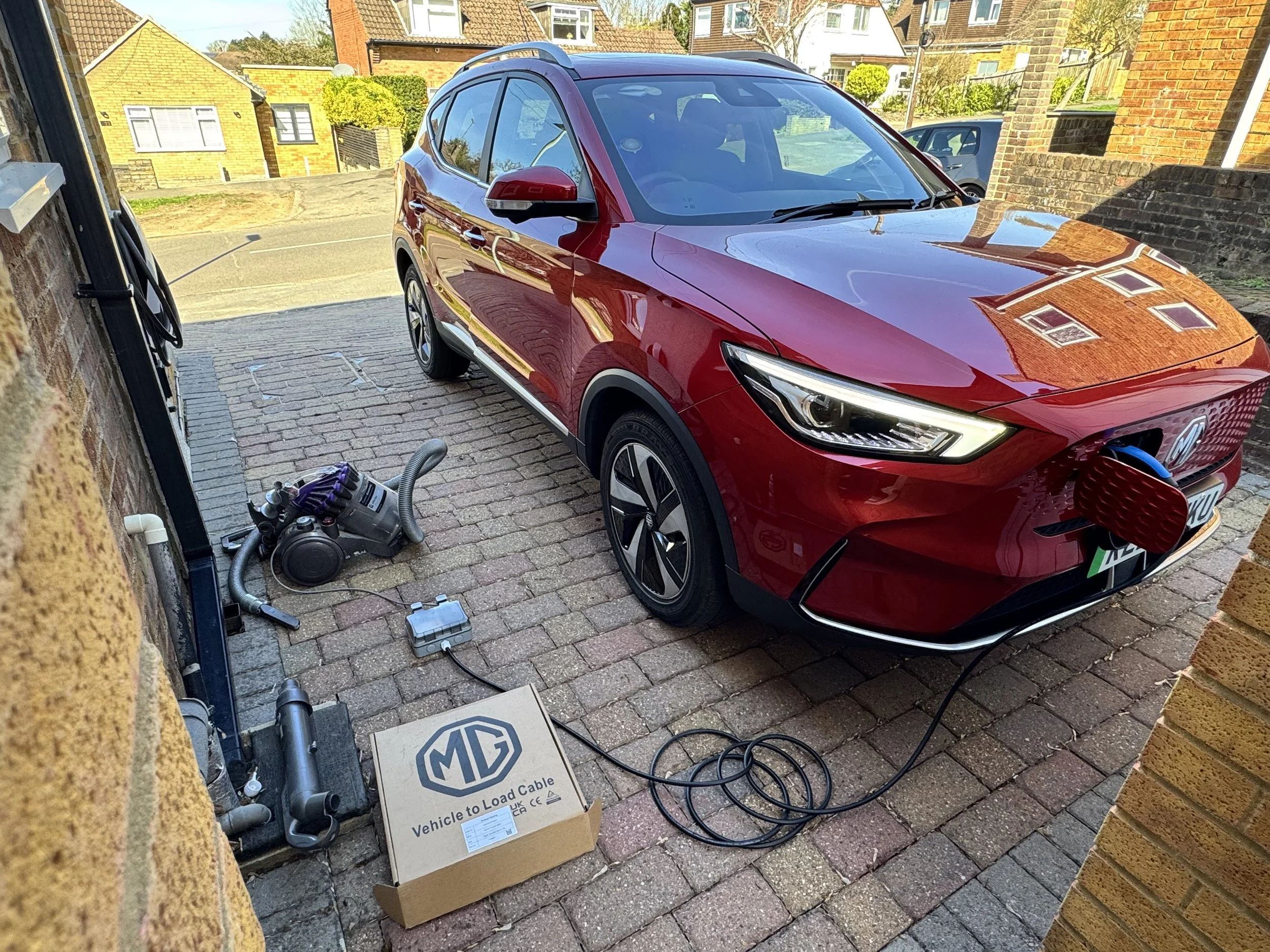
Vehicle to Load (V2L) Adapter powering a vacuum cleaner
Not all EVs are capable of bi-directional charging, but it’s now becoming an increasingly popular addition to new vehicle line-ups which is often mentioned in our articles.
I expect the industry to start make inroads into allowing for better capabilities especially around V2H and V2L.
———
About the Author
Graeme Cobb is a lifelong car enthusiast with a passion for writing about cars, EVs, industry updates and more.
You can find Graeme on 𝕏 at @graeme_cobb or YouTube @REV-EV.