September new car market is strong with a clear shift to electrification
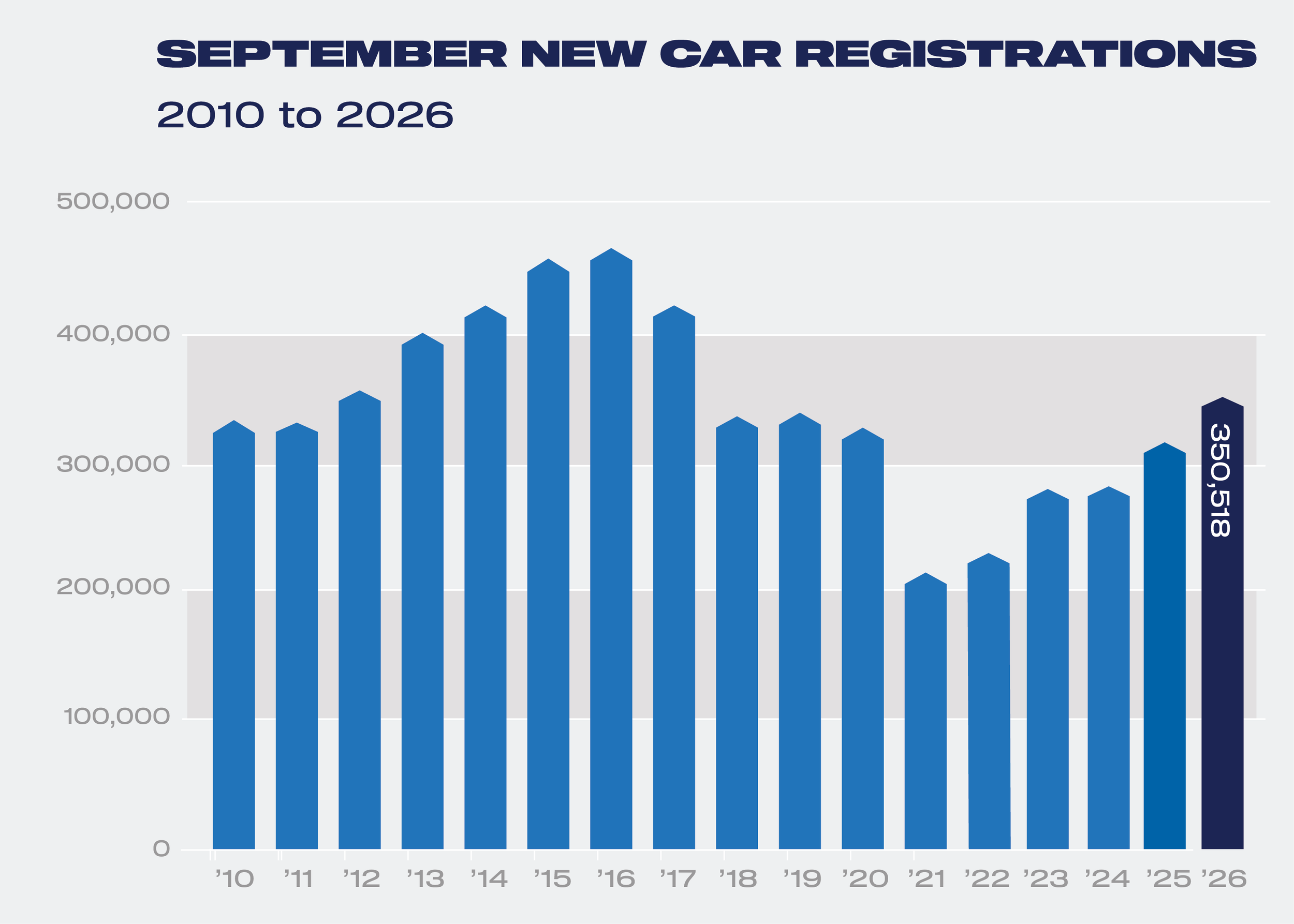
The new car market is showing signs of strength as it grows 12.1% to 350,518 units in the September number plate change. This is the 10th consecutive month of growth and strongest September since 2017.
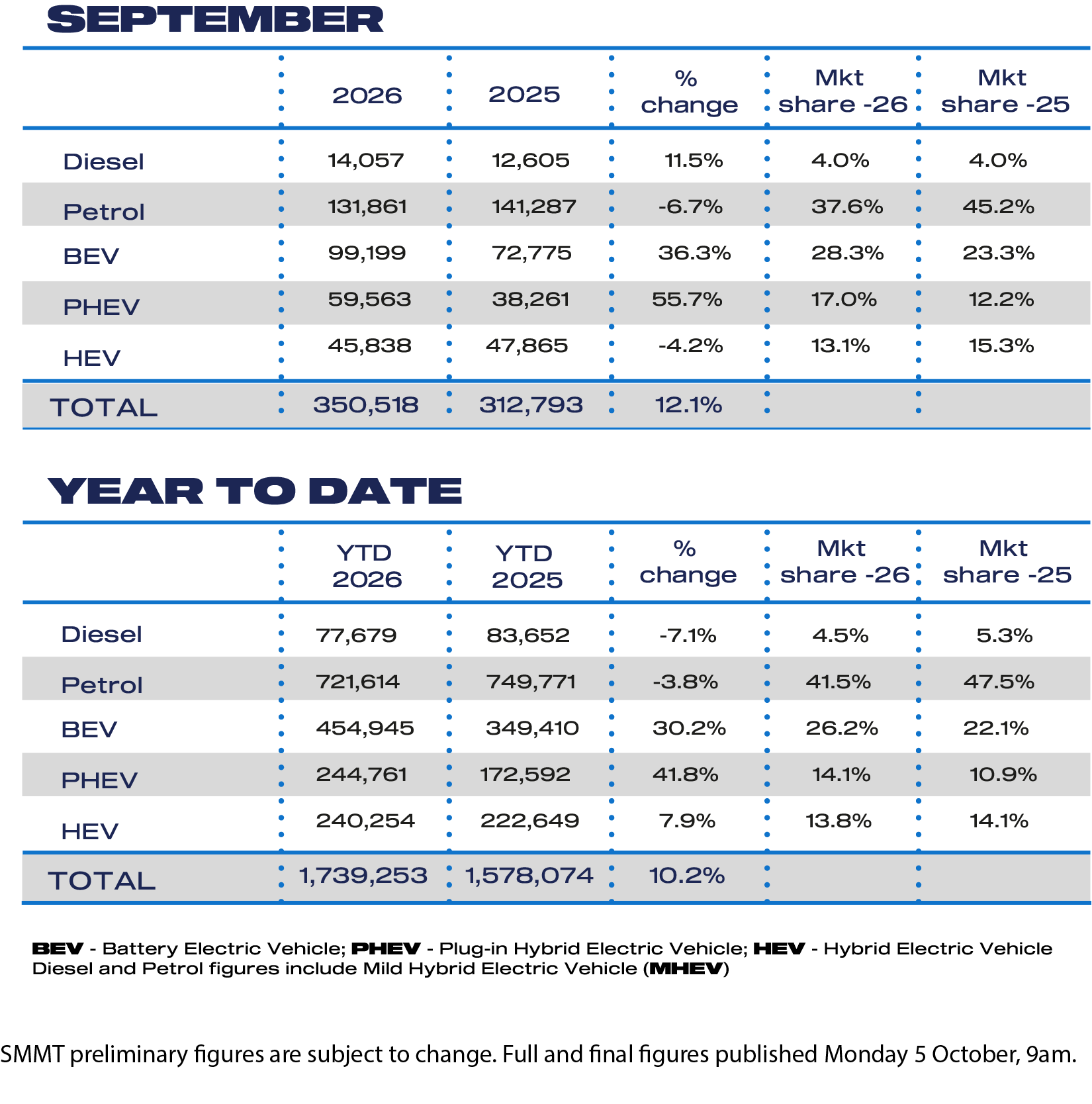
There has also been a record 99,199 battery electric cars joining the roads last month as buyers respond to greater model choice, manufacturer incentives, government grants and growing concerns over fuel prices and now the threat of diesel shortages.
New Car Growth
September 2026 saw the 10th consecutive month of growth and the strongest September since 2017.
Consumer confidence has clearly returned as more cars are delivered to customers despite the economic headwinds, and at a time when choice is abundant from new market entrants.
Registrations by Fuel Type
Going through the numbers in market share order identifies the winners and losers in new car registrations, plus some surprising results, too.
Caveating the below stats SMMT includes mild hybrids into Petrol and Diesel registrations as their electrical systems do not drive the wheels, instead, they offer very small efficiency improvements due to better low voltage battery management.
Petrol Registrations
Petrol registrations have shown a significant decline of 6.7% taking 37.6% market share, down from 45.2% a year ago with 131,861 units exchanges hands.
The year-to-date picture looks similar with a 41.5% market share for January - September vs 47.5% for the same period last year, with the possibility that 2026 could close out with petrol registrations falling below 40% market share for the year.
Battery Electric Registrations
The headlining figure showing a record 99,199 registrations for battery electric cars, but this still falls short of the ZEV mandate’s 33%. However, sentiment is shifting towards EVs in greater numbers as registrations surge 36.3% vs September last year capturing 28.3% market share, up from 23.3% a year ago. Pump prices that have consistently risen for the year may be a contributing factor to the success of the battery electric car.
But, it’s the year-to-date numbers that matter with only three months left of 2026, the market share is just 26.2% where it needs to be nearer to 30% to ensure targets are met with current ZEV mandates (currently under its annual consultation) and its flexibilities.
Plug-in Hybrid
Curiously a very popular choice when new, but it’s not repeated on the used market, PHEV’s take the largest surge in demand that sees a huge 55.7% swing to plug-in hybrid models, which now command 17% market share. This is up from 12.2% a year ago, whilst year-to-date numbers reflect a 41.8% uplift taking market share to 14.1% for the year so far.
Hybrid
The surprise comes from hybrids as its actual market share has fallen, showing signs of weakness despite offering fuel savings over un-assisted [by electricity] internal combustion engines. With market share declining by 4.2% to 13.1%, down from 15.3% in September 2026, it seems offering cost savings on liquid fuels might not be enough for customers, despite September being the new registration plate month.
Revealing the year-to-date figures pitches hybrids at 13.8% in 2026 so far compared to 14.1% at the same point a year ago. That represents a 7.9% decline in market share, however the number of units shifted has increased.
Diesel
Surprise number two comes from diesel, which has remained flat year-on-year, albeit it has shifted 1,500 more units than it did in September 2025 indicating that diesel’s decline may have reached the bottom.
However, its not enough to reverse the decline in registrations year-to-date with diesel market share dropping to 4.5% for January through to September vs the same period a year ago, and that could fall to just 4.0% market share for the full year by the end of 2026.
Sectors
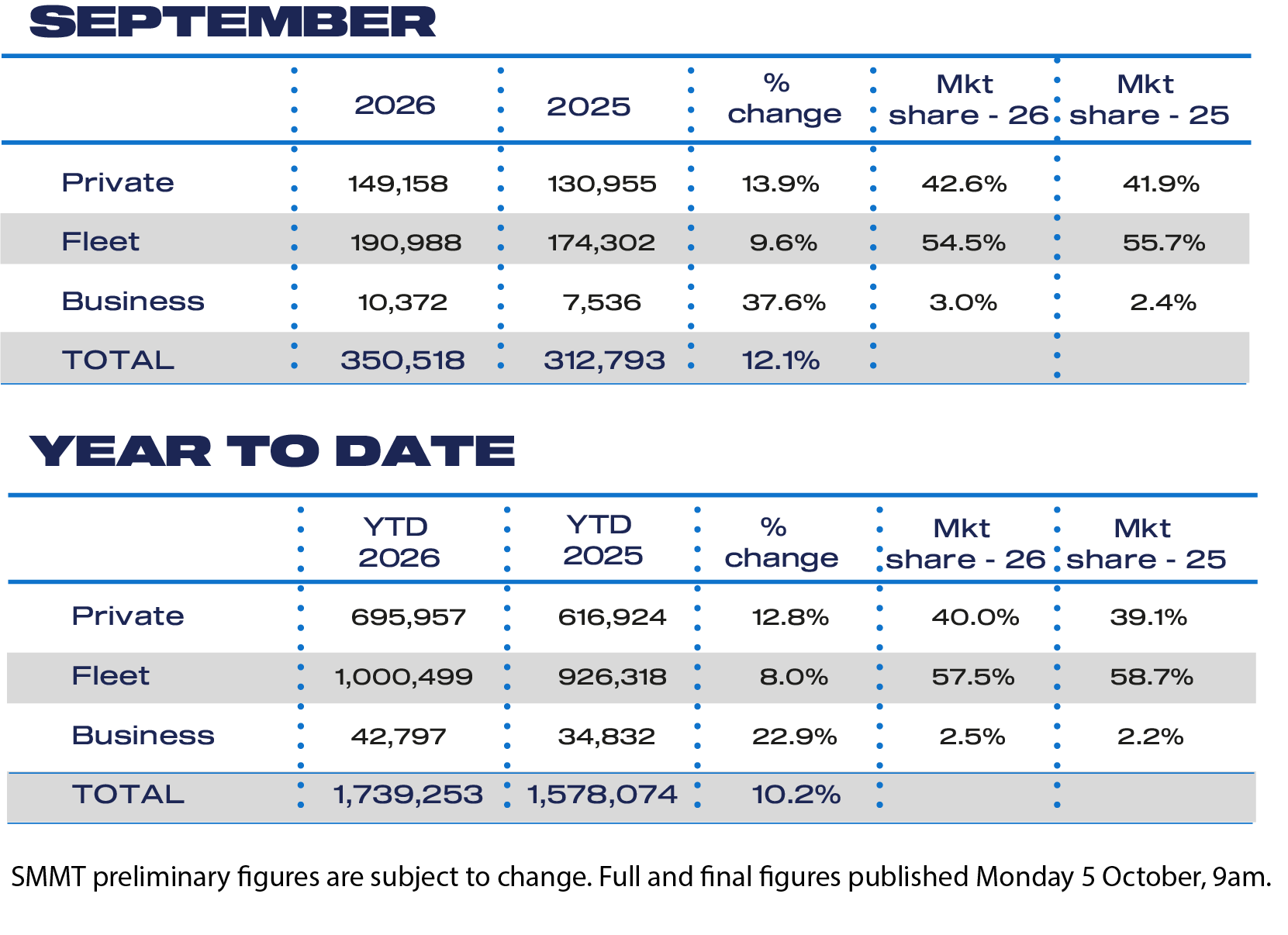
Sectors are split into three types; Private, Fleet and Business with Fleet accounting for lease, salary sacrifice, and company car leases.
Private
The private sector, comprising of vehicle purchases and financed purchases, shows a 13.9% shift in market share with the private registrations taking 42.6% market share, up from 41.9% a year ago.
Whilst year-to-date shows similar trends with private buyers growing 12.8% this year so far, accounting for 40.0% market share, up from 39.1% from the same point last year.
Fleet
Fleet registrations continues its decline, and despite more units changing hands, market share has actually declined from 55.7% to 54.5% in September 2026, with the year-to-date decline from 58.7% market share to 57.5%.
Business
In another surprise, business market share has jumped to 3.0% market share, up from 2.4% in September 2025. Market share also increased between January - September this year, accounting for 2.5%, up from 2.2% a year ago.
Best Sellers
Perhaps my favourite piece of data as its always fascinating to see the changes in leadership when it comes to which manufacturers has shifted the most cars.
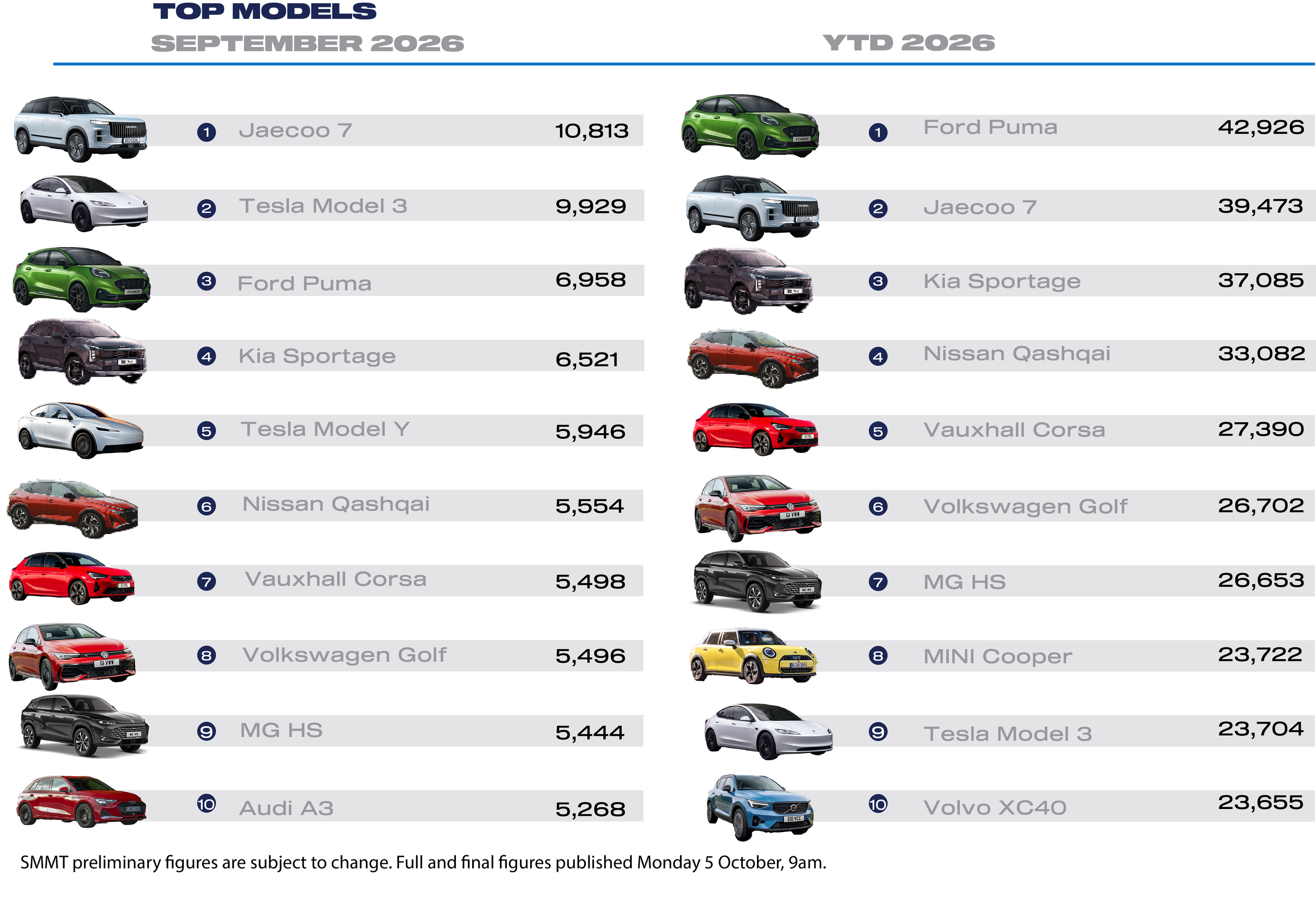
September has shown some huge swings in sentiment with the now formidable Jaecoo 7 taking pole position, offering plug-in hybrids with long ranges, long warranties and high specs for very competitive prices.
Tesla takes number 2 and 5 position with the Model 3 and Model Y selling in larger volumes. Often these will disappear and reappear in the top 10 as Tesla can’t deliver enough vehicles for consistency with numbers from month-to-month.
The Ford Puma, Britain’s overall best seller, has once again dropped out of the top spot taking 3rd pace, shortly following by the Kia Sportage. The Vauxhall Corsa, Volkswagen Golf, MG HS and Audi A3 take up 6th to 10th place respectively.
Year-to-Date shows the cumulative numbers per make and model for the year so far showing the Ford Puma at the top of the charts with the Jaecoo 7 hot on its heels. The Jaecoo 7 may even see the Puma dethroned by year end.
The Kia Sportage is consistently in 3rd place followed closely by the Nissan Qashqai in 4th, the Corsa in 5th, followed by the Golf, MG HS, MINI Cooper, Tesla Model 3 and Volvo XC40.
Battery Electric Car Charts
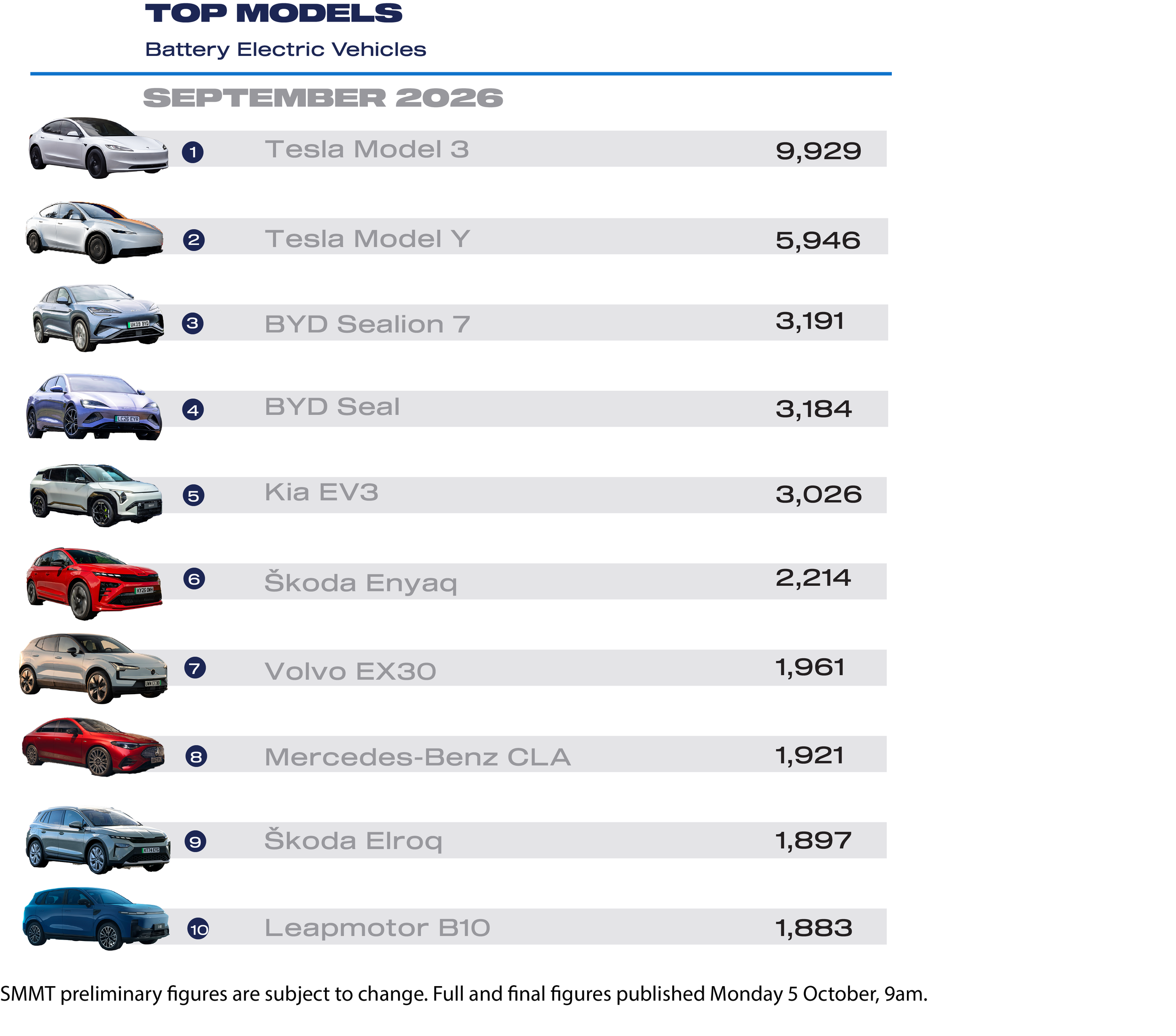
In a new feature, the Battery Electric Car data shows the top models registered for September 2026 with a few surprises thrown in.
BEV Top Models
Tesla is having a huge success selling its Model 3 and Model Y as they take number 1 and 2 positions by a wide margin, with the BYD Sealion 7 SUV coming in 3rd spot, with the BYD Seal just 7 cars behind in 4th.
The KIA EV3 and Skoda Enyaq take 5th and 6th with the Volvo EX30, Mercedes CLA, Skoda Elroq and Leapmotor B10 taking up the remaining top 10 model positions in that order.
Mike Hawes, SMMT Chief Executive says “September’s record EV performance is a major achievement. Drivers are increasingly embracing the growing choice of models made available and high fuel prices are also undoubtedly giving more consumers reason to consider going electric. The industry’s commitment is clear with billions of pounds of investment in new models, new technology and incentives.
Despite all these factors, uptake remains behind mandated targets and, whilst flexibilities help, the UK still has the world’s toughest targets and highest energy costs. The Mandate review is an opportunity to review those factors, to build on this momentum and support consumers but, in doing so, strengthen business viability and UK competitiveness.”
———
About the Author
Graeme Cobb is a lifelong car enthusiast with a passion for writing about cars, EVs, industry updates and more.
You can find Graeme on 𝕏 at @graeme_cobb