
Renault’s Filante: The EV That Just Made a Quiet Point About Range Anxiety
Renault has built a car you can’t buy, probably wouldn’t want to own, and yet absolutely should pay attention to.
It’s called the Filante Record 2025, and it exists for one reason: to find out how far an electric car can really go if you stop designing it like a tall, bluff-fronted family appliance and start treating efficiency as the main event.
The answer is more than 1,000km on a single charge, driven at proper motorway speeds. Which is not ideal news for anyone still convinced EVs fall over the moment they leave the suburbs.
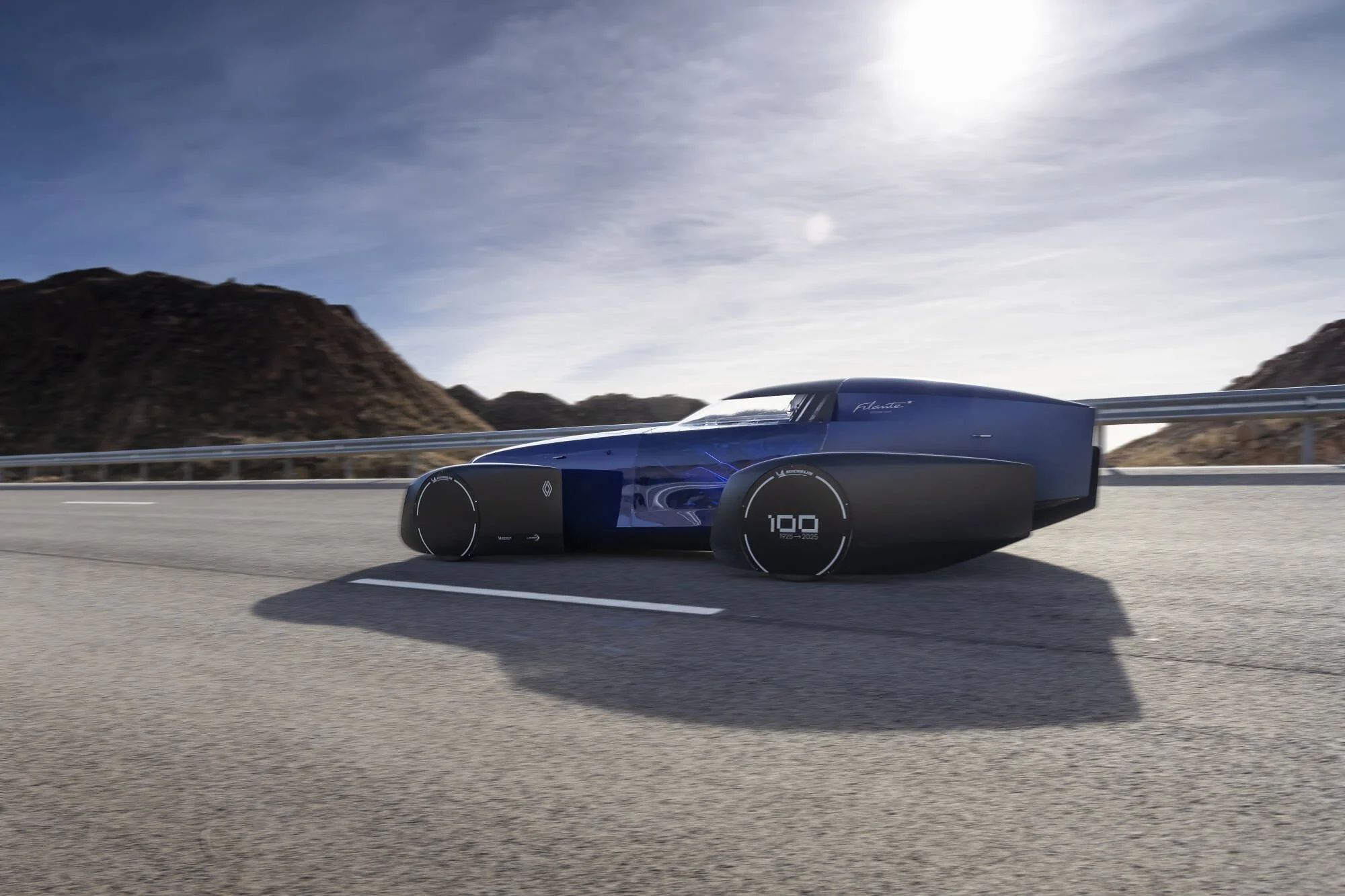
The Record Breaking Renault Filante EV
What Is the Filante, Exactly?
This is not a future Renault model and it’s not a teaser for something coming to showrooms. The Filante is a one-off experimental vehicle, built as a rolling laboratory.
Think of it less as a car and more as a very expensive engineering argument.
It’s single-seat, extremely low, long and narrow, with a shape that looks like it was drawn by people who genuinely enjoy wind tunnel data. Practicality is not just an afterthought here, it’s been actively ignored. No rear seats, no boot to speak of, and styling that prioritises airflow over aesthetics or parking convenience.
All of this is deliberate.
The Headline Claim, Minus the Hype
Renault drove the Filante for just over 1,000km, averaging a little over 100km/h. That puts it squarely in real motorway territory, not slow-speed hypermiling designed to produce a flattering headline.
More importantly, it didn’t rely on a comically oversized battery to do it. The Filante uses an 87kWh battery, roughly the same size you’ll find in Renault’s current large electric family cars.
It also didn’t limp to a halt at the end. There was still usable charge remaining, which suggests the headline number isn’t a one-in-a-million fluke.
In efficiency terms, the car used well under 8kWh per 100km. That’s dramatically better than what most production EVs manage at similar speeds, and it’s the bit that really matters.
How It Managed It
There are no magic tricks here, just ruthless optimisation.
First, aerodynamics. This is where most modern cars, especially SUVs, quietly sabotage themselves. The Filante’s shape is designed to slip through the air with as little resistance as possible, which pays huge dividends at motorway speeds.
Second, weight. Despite carrying a large battery, the Filante weighs around a tonne. That’s lighter than many everyday electric cars and even some petrol ones.
Third, engineering minimalism. Steer-by-wire and brake-by-wire systems reduce mechanical complexity. The interior is stripped back to essentials. Nothing is included unless it directly helps efficiency.
This is what happens when engineers are allowed to win every argument.
The Obvious Caveats
Before this turns into yet another round of “EVs solved forever” takes, a bit of realism helps.
This was a controlled test, not a winter drive through roadworks, traffic jams and sideways rain. The Filante also makes compromises no normal buyer would tolerate, including space, usability and basic comfort.
So no, this doesn’t mean your next electric crossover will suddenly do 1,000km between charges. And no, it doesn’t mean charging infrastructure no longer matters.
Why It Still Matters
What the Filante actually demonstrates is that range anxiety is, to a large extent, a design problem.
If manufacturers focus more on efficiency and less on bulk, batteries don’t need to keep getting bigger, heavier and more expensive. Better aerodynamics and smarter energy use can deliver meaningful real-world range gains without turning cars into rolling battery packs.
This is also where some of the louder anti-EV talking points quietly fall apart. The idea that electric cars are fundamentally incapable of long-distance travel simply doesn’t hold up when efficiency is taken seriously.
The Filante itself will remain a concept. But the lessons it exists to teach will filter into production cars over time, often in ways buyers won’t consciously notice but will definitely benefit from.
The Takeaway
Renault hasn’t built the ultimate electric car. It’s built a proof of concept that shows how much untapped potential still exists when efficiency is treated as a priority rather than a side quest.
The Filante doesn’t end the EV debate, and it doesn’t magically fix every real-world limitation. What it does do is move the conversation forward, calmly and convincingly, without shouting about it.
And sometimes, that’s far more effective.
