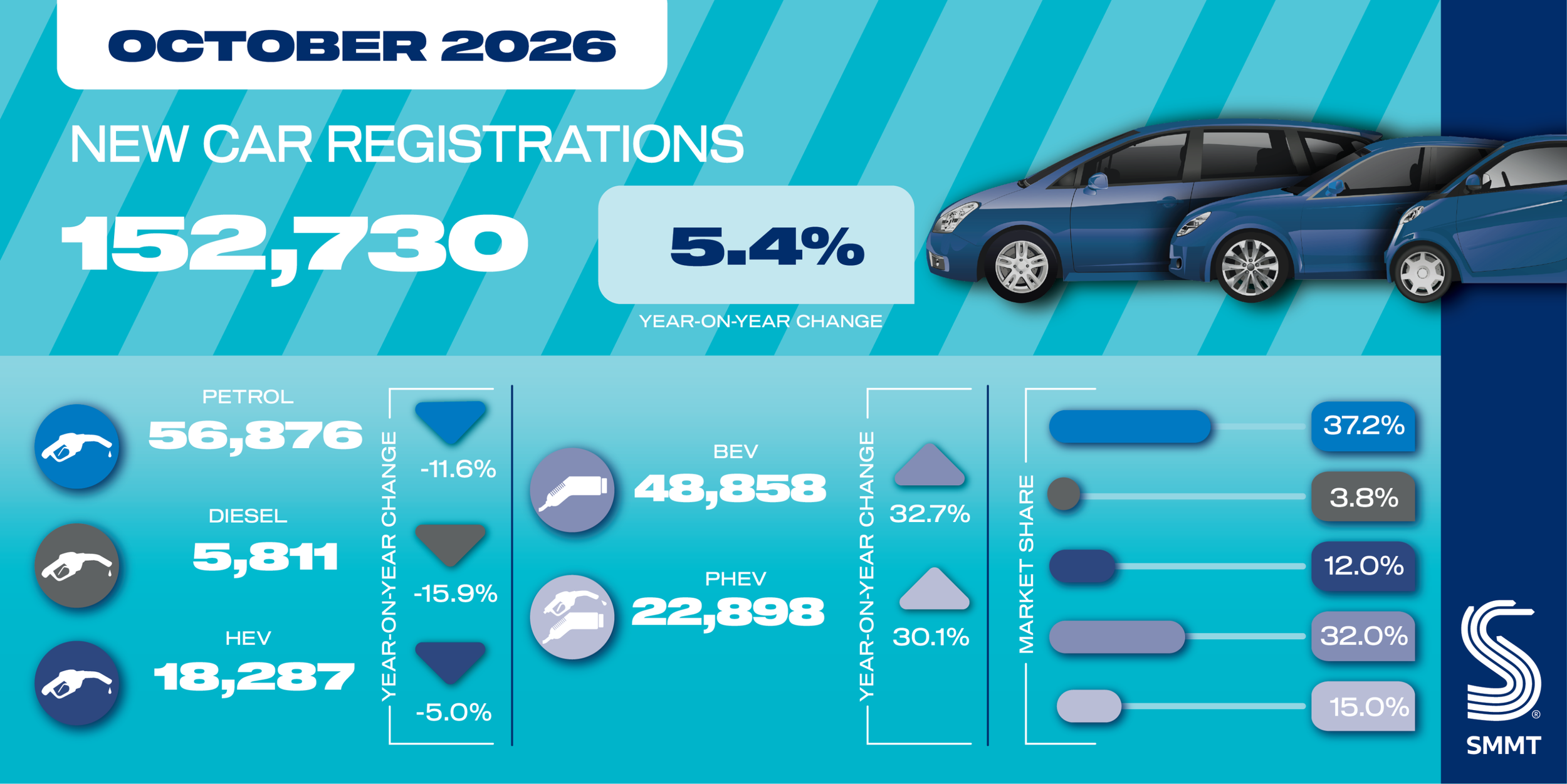
With conflict in the Middle East keeping pump prices high, drivers are shifting away from petrol, diesel and hybrid cars and seeking to lower ongoing running costs via the plug. However, that conflict hasn’t put people off from taking the plunge and ordering a new car as October 2026 has shown both an increase in manufacturing output and a 5.4% year-on-year increase in volumes of cars registered.
Registrations by Fuel Type
Market share is the metric for how new vehicle registrations compare on fuel type with petrol cars still the dominant choice, but that lead is slipping with battery electric cars closing the gap.
Petrol Registrations
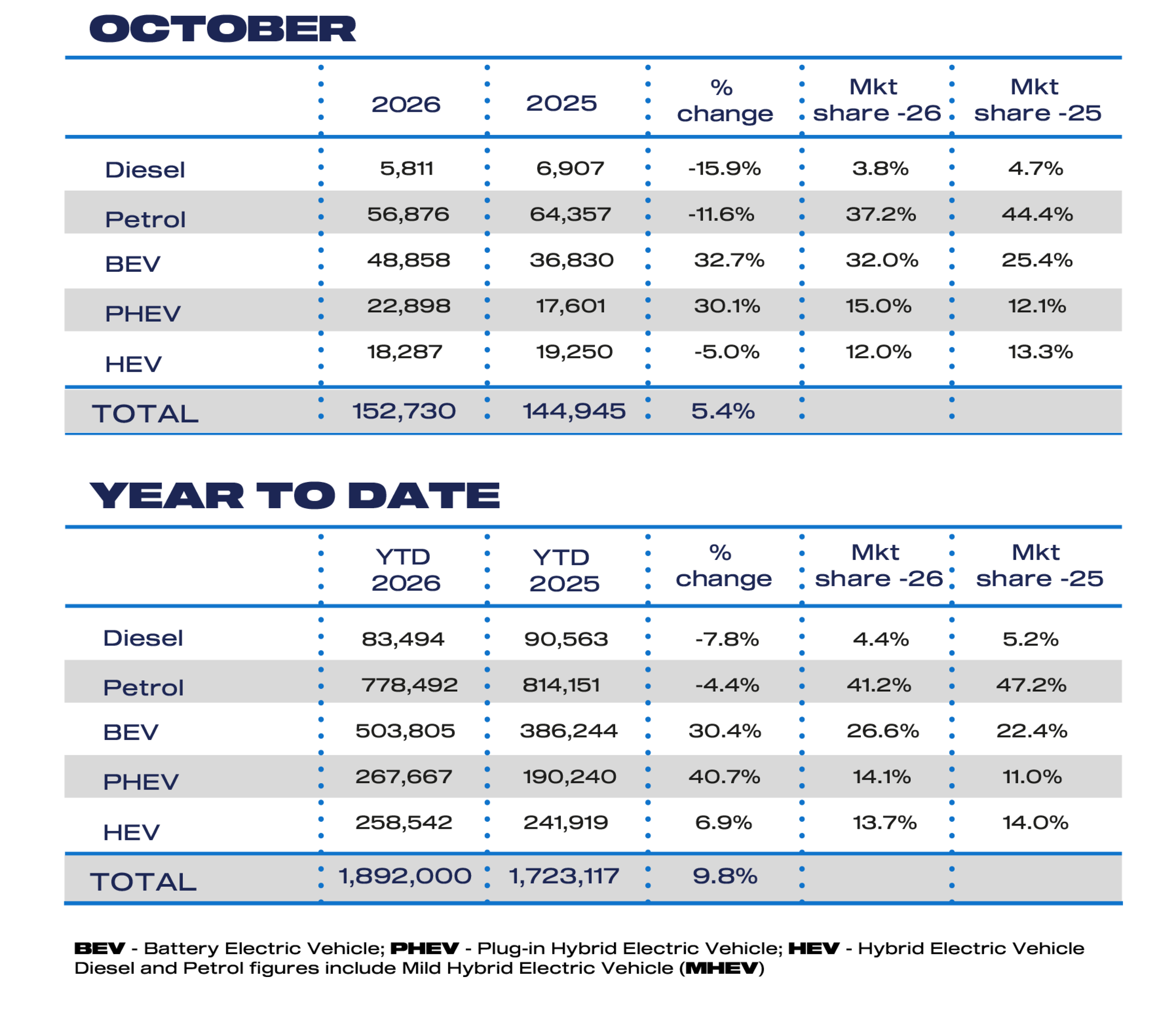
Market share has dropped 11.6% year-on-year accounting for 37.2% of all new car registrations, and slipping half a percentage point from September. Volumes of cars dropped, too, with 7,481 fewer petrol cars hitting the roads in October 2026 vs the same time last year.
Year-to-Date numbers reflect a 4.4% drop in market share down to 41.2% vs the same period last year. Just over 814,151 units were registered by October 2025, with October 2026 showing a decline to 778,492 units.
Clearly the Middle East conflict is having an impact at a time when the number of EV models available increased from 130 at the start of 2025, to over 180 by October 2026, piling pressure on traditionally fuelled cars such a petrols.
Battery Electric Registrations
Electric cars came a close second behind petrol, harvesting 32.7% market share, which is an increase of 32% year-on-year. Volumes increased by 12,028 units, too, showing a clear indication that the cost of petrol or diesel has reached a tipping point for many looking to reduce ongoing fuel costs.
Whilst year-to-date registrations of 26.6% looking like a ZEV mandate miss, it’s a 30.4% increase in market share compared to the same point last year. With the ZEV mandate dictating 33% sales are battery electric for 2026, last year that target was 28% and, at the same point last year, new EV registrations stood at 22.4% with just two more months left for the year, yet with flexibilities the target was met. The same will happen this year, too, with BEV share is expected to reach 27.2% by the end of 2026, according to the SMMT.
Battery electric volumes passed the half a million units in October 2026 standing at 503,805 cars registered this year so far, representing a significant increase from 386,244 a year ago.
Plug-in Hybrid Registrations
Drivers are seeking alternatives that have a plug as new PHEV registrations increased 30.1% compared to October 2025, and stand at 15% market share, up from 12.1% a year earlier. And this increase is in part due to the high cost of petrol and diesel, but also thanks to Chinese Manufacturers launching many new plug-in products, with Jaecoo selling well. More on that later.
Year-to-date shows a larger swing of 40.1% compared to the same cumulative point in 2025, taking 14.1% market share, up from 11.0%.
A year ago, the number of units sold in 2025 through to October stood at 190,240, with October 2026 showing cumulative totals for the year so far reaching 267,667 units.
Hybrid Registrations
A surprise turn shows Hybrid cars falling in market share taking 12.0% of the market compared with the same cumulative point in 2025, which showed a 13.3% market share. Units registered stayed flat.
Year-to-date paints a similar picture with a decline in market share from 14% in 20205 to 13.7% in 2026, however, more units were sold with 258,542 units registered in 2026 so far compared to 241,919 in 2025.
With fuel prices as high as they are, more people are turning to the plug to extract significantly better efficiency, despite hybrids offering excellent fuel-sipping performance with longer periods between refuelling.
Diesel
It’s a bleak picture for diesel fans with market share in October 2026 accounting for just 3.8% of all car registrations. This marks a 15.9% decline compared to October 2025, with units shifted declining from 6,907 to 5,811. Market share stood at 4.7% a year ago.
Year-to-date number also declined 7.8% despite new diesel products being launched, taking a 4.4% market share compared to 5.2% for the year through to October 2025. Units shifted also fell from 90,563 to 83,494 marking diesel as a near-niche choice for the consumer, and the contributing factor to the decline of the diesel perhaps lies with prices reaching a very painful £2 per litre on average this year.
Sectors
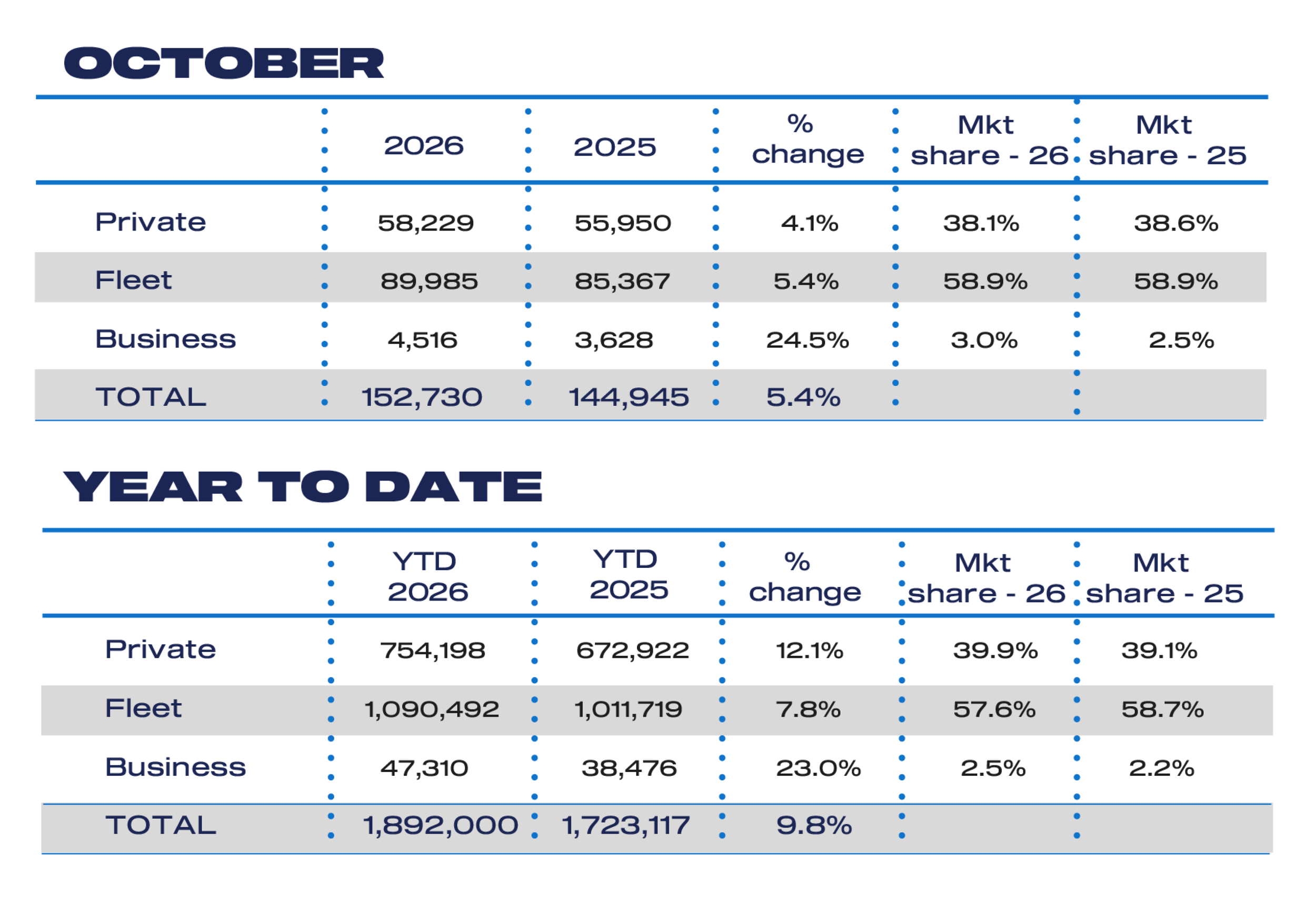
Sectors are split into three types; Private, Fleet and Business with Fleet accounting for lease, salary sacrifice, and company car leases.
Private
Private vehicle registrations shows a slight pullback in market share from 38.6% in October 2025 to 38.1% in October 2026, although 4.1% more units were registered, taking private registrations to 58,229 units in October 2026 compared with 55,950 units for the same month last year.
However, year-to-date registrations show a natural trend upwards for market share taking 39.9% of all registrations for the year up to October 2026, a 12.1% increase from 672,922 a year ago.
Fleet
Fleet market share remained static at 58.9%, with a 5.4% increase in units from 85,367 to 89,985 units registered in the month of October compared to the same month last year.
Market share for the first 10 months of the year declined to 57.6% from 58.7% a year ago with only an increase of 78,773 units to 1,090,492 cars registered.
Business
The big surprise comes from the Business sector with a significant shift of market share, up 0.5% to 3.0% for October 2026, increasing volumes registered to 4,516, up from 3,628 a year ago.
Year-to-date is similar showing a 2.5% market shared for the first 10 months of 2026 compared with 2.2% at the same point last year. Volumes registered grew 23.0% to 47,310 up from 38,476 at the same point last year.
Best Sellers
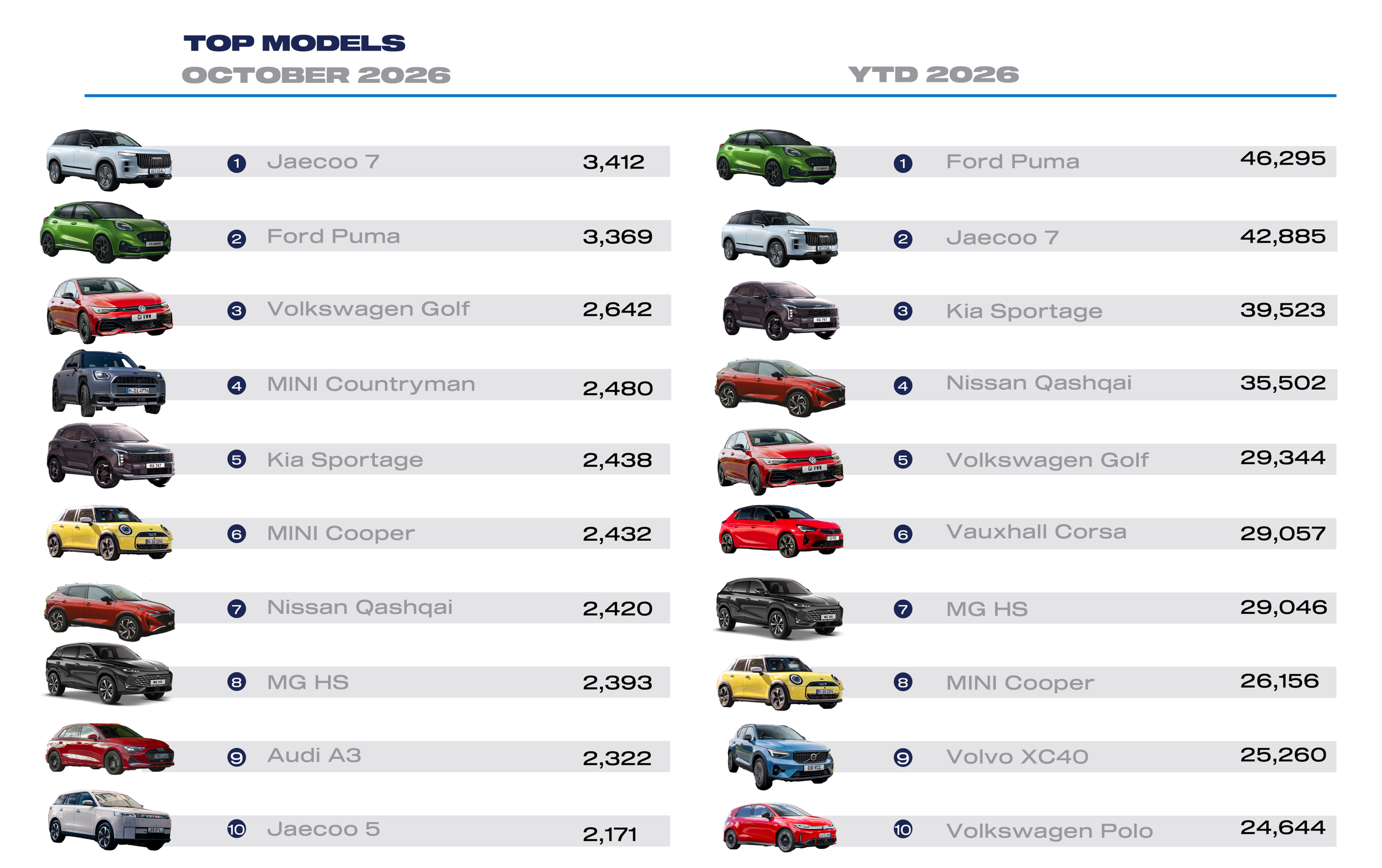
The most fascinating data is with the monthly swings in preferences for specific vehicles, and this month holds surprises, too. The top 10 are not broken down by fuel type, so it’s a complete mix of petrol, hybrid, plug-in hybrid, electric, but perhaps not diesel.
October 2026
The biggest surprise is the Jaecoo 7 has maintained its lead over the Ford Puma, to take number 1 spot in the sales charts. With the Puma relegated to second position, Volkswagen has put on an impressive performance to take 3rd spot, with the Mini Countryman and Kia Sportage in 4th and 5th place.
Languishing in the 6th to 10th positions are the MINI Cooper hatchback in 6th, followed by the once formidable Nissan Qashqai coming in 7th, with the MG HS, Audi A3 and Jaecoo 5 in 8th, 9th and 10th place respectively.
Year-to-Date
Jostling for top spot to claim the most cumulative totals for 2026 is the Ford Puma with a small lead of 3,410 units over 2nd place held by the Jaecoo 7.
The Kia Sportage comes in a solid 3rd place separated by only a few thousand units compared to the Jaecoo, with the Nissan Qashqai claiming 4th spot. And sitting in the middle is the Volkswagen Golf closely followed by the Vauxhall Corsa by just a couple of hundred units.
In 7th place is the MG HS, with the MINI Cooper hatchback, Volvo XC40 and Volkwagen Polo taking 8th, 9th and 10th place.
Battery Electric Car Charts
For the second time only, SMMT has provided us with Battery Electric Car data showing the top models registered for October 2026, plus a few surprises thrown in.
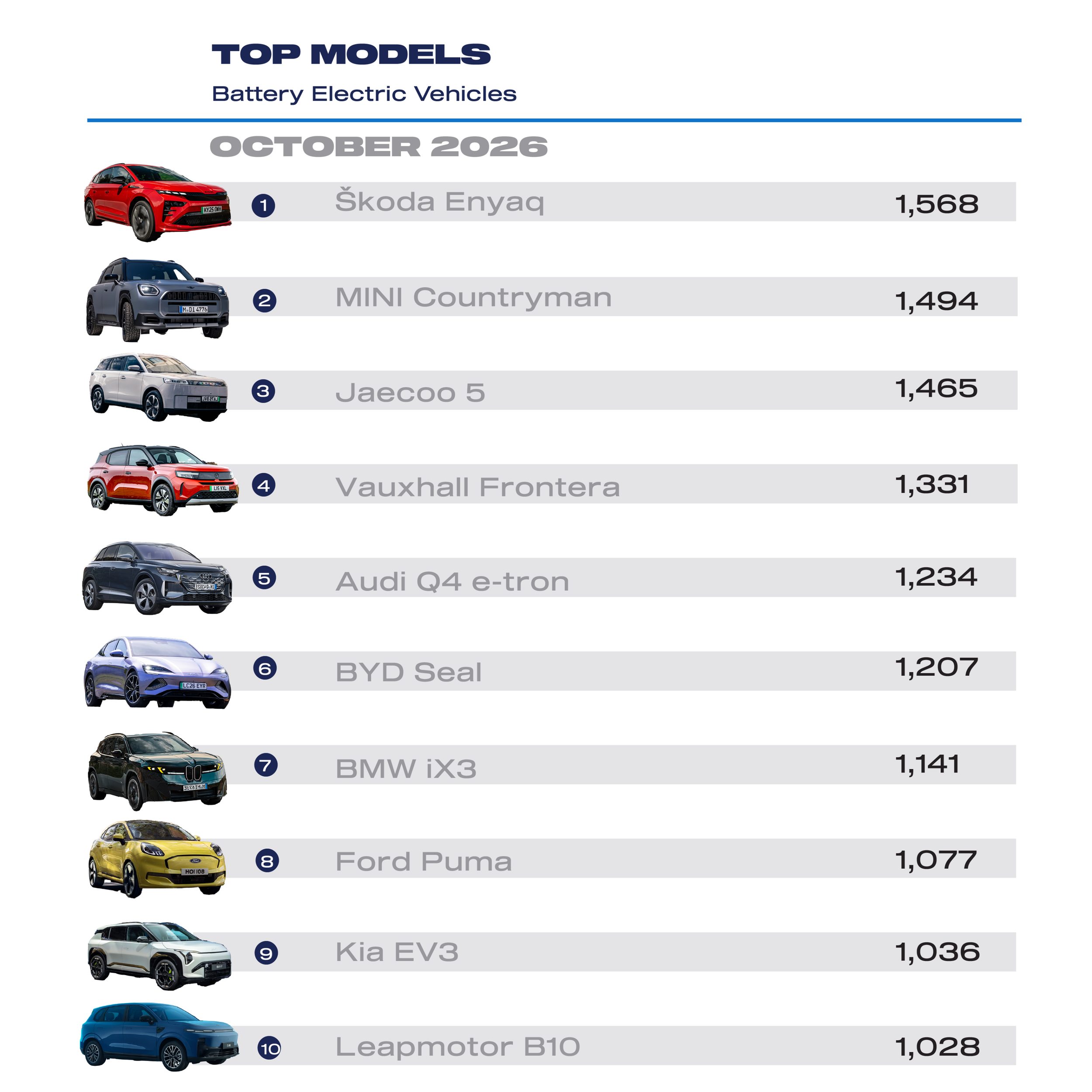
BEV Top Models
With Tesla dominating last month with 1st and 2nd place, they have fallen out of the top 10 entirely giving way to the Skoda Enyaq in 1st, although volumes are 84% lower compared with former leader from the Tesla Model 3 last month. The MINI Countryman electric comes in second place.
Jaecoo’s only EV model, the Jaecoo 5 takes 3rd place, whilst the Vauxhall Frontera takes 4th spot.
Audi’s refreshed Q4 takes the middle ground with a 5th place position and the BYD Seal taking 6th place and the all-new 500-mile range BMWiX3 takes 7th, which is remarkable given its premium price.
In the last three places is the Ford Puma, Kia EV3 and Leapmotor B10.
Mike Hawes, SMMT Chief Executive, said, “Almost one in three new cars registered in October was electric – great progress in the transition, but one that comes at enormous cost. The industry and government are spending billions to help drivers switch, but that support cannot be sustained indefinitely with the gap to mandated targets set to more than double by 2028, just as a new EV-only tax is introduced. Higher targets may force supply, but they do not create demand. The ZEV Mandate review must deliver substantive reform effective immediately to ensure we have a healthy market and an attractive pitch to investors.”
———
About the Author
Graeme Cobb is a lifelong car enthusiast with a passion for writing about cars, EVs, industry updates and more.
You can find Graeme on 𝕏 at @graeme_cobb