
Cheaper than a Corsa? Hyundai’s new electric hatchback starts at £18,495 after the UK government grant. The longer-range version costs from £21,995 and has a claimed range of up to 308 miles.
Electric cars accounted for more than a quarter of UK new-car registrations in the first nine months of 2026. The choice of affordable models is growing, too, with the Kia EV2, Cupra Raval, Honda Super-N and Volkswagen ID. Polo all competing for your money.
The Hyundai IONIQ 3 joins them from just £18,495, including the government’s £3,750 Electric Car Grant. That’s less than a base-spec petrol Vauxhall Corsa and it gets you a five-seat IONIQ 3 in Advance trim with a 42kWh battery. Much like with the Kia EV2, the entry level 61kwh option Advance offers you the longest range at 308 (WLTP) whilst costing just £21,995. The more expensive trim levels add equipment and larger wheels, but have shorter quoted ranges.
Design and practicality
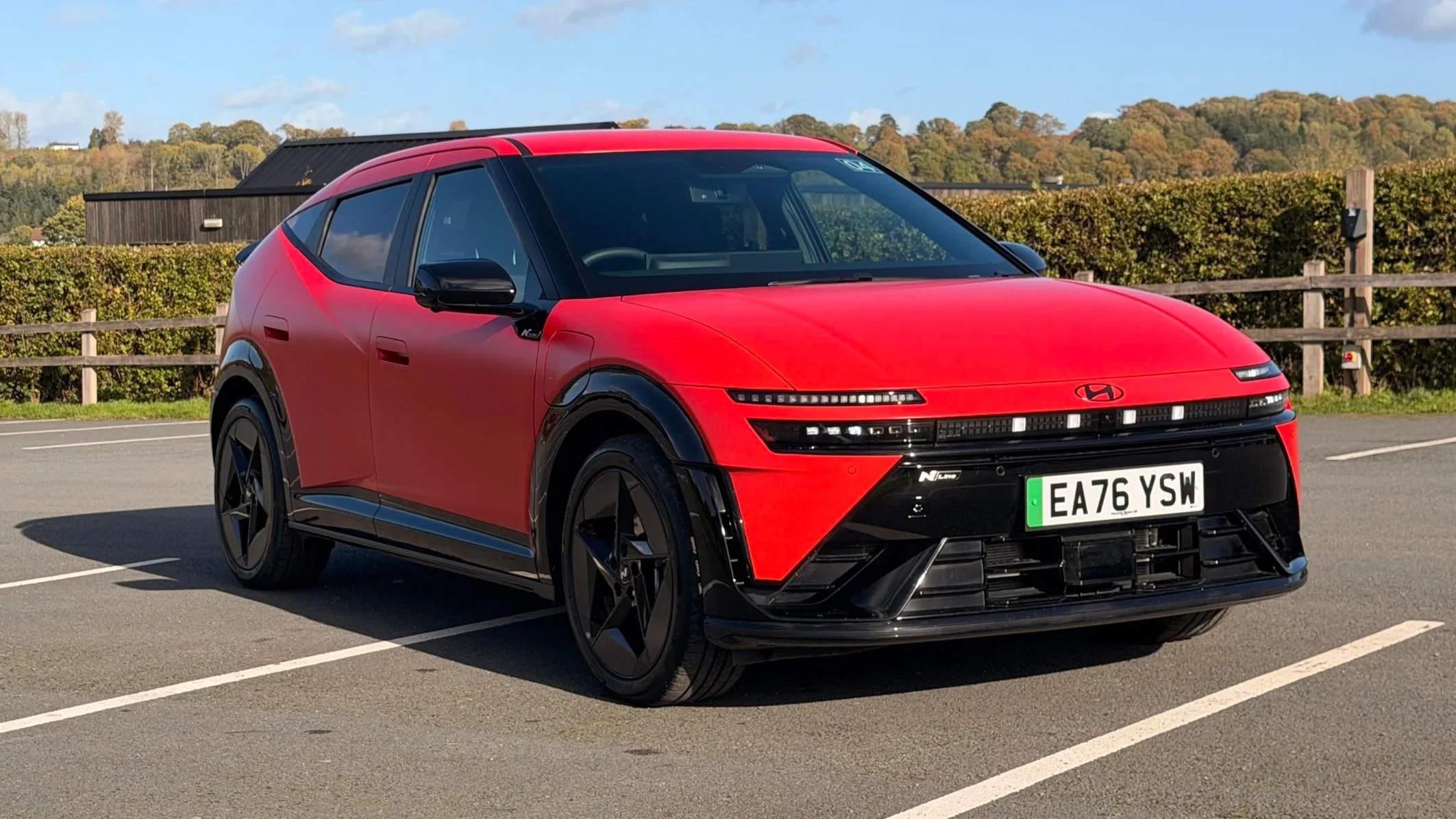
Hyundai calls the IONIQ 3 an ‘Aero Hatch’, with a slippery shape developed to reduce drag while retaining cabin space. It quotes a drag coefficient of 0.263, while the pixel lighting gives it an obvious IONIQ family resemblance. The car measures approximately 4.16 metres long.
Boot capacity is 441 litres, including the Megabox underfloor storage, rising to 1,213 litres with the rear seats folded. There is an adjustable boot floor and a 60:40 split rear bench. Inside, an open centre console provides more storage, and the cupholders adjust to accommodate larger drinks bottles and cups.
Whilst the rear passenger space is very impressive (it can accommodaåte 3 adults in the back), toe space is somewhat limited by the high floor combined with the low drivers’ seat; this is a common trait on Hyundai EV’s, one that I hope becomes consigned to history in future models.
Interior and technology
Hyundai’s new Pleos Connect infotainment system is based on Android Automotive OS. It uses a 12.9-inch touchscreen in most versions, with the N Line Evo getting a larger 14.6-inch display. Wireless Apple CarPlay and Android Auto are standard, so drivers can continue using their preferred phone apps.
Advance is already well equipped, with dual-zone climate control, a reversing camera, front and rear parking sensors and adaptive cruise control with stop-and-go functionality. LED lights and 16-inch alloy wheels are standard, too.
Premium adds 17-inch wheels, a separate 9.9-inch digital instrument display, wireless phone charging, electrically folding mirrors and battery pre-conditioning. Pre-conditioning prepares the battery for a rapid-charging stop.
Batteries and range
There are two battery choices, marketed as 42kWh and 61kWh. The smaller pack is listed at 42.2kWh in Hyundai’s technical data and is paired with a 147PS motor. The larger battery gets 135PS. Both drive the front wheels and produce 250Nm of torque, so spending more on the battery buys extra range rather than extra power.
Hyundai quotes up to 213 miles for the smaller-battery Advance and up to 308 miles for the 61kWh version. If most of your driving is local and you can charge at home, the smaller battery may be enough. Regular longer journeys are a better reason to find the extra £3,500 for the 61kWh car.
Hyundai’s detailed launch specification gives provisional ranges of 303 miles for Premium, 300 miles for Ultimate and 265 miles for N Line Evo, subject to final homologation. The N Line Evo is therefore 43 miles short of the long-range Advance on those figures.
Charging
There’s no 800v platform here, perhaps not surprising at this price point. The IONIQ 3 uses a 400-volt electrical architecture. Maximum DC charging rates are 119kW for the smaller battery and 110kW for the larger one, with Hyundai quoting 10–80 per cent charging times of approximately 29 and 30 minutes respectively under suitable conditions.
Both versions are listed with an 11kW onboard AC charger. Not class leading by any stretch of the imagination, but certainly acceptable for a car in this price range.
For a 7kW home wallbox, Hyundai estimates a 10–100 per cent charge at six hours and 20 minutes for the smaller battery, or eight hours and 35 minutes for the larger one.
An optional heat pump costs extra, but is only available on Premium, Ultimate and N Line Evo trims. It comes as part of the £1,250 EV Pack, which also adds vehicle-to-load functions for powering external devices. I understand why some manufacturers don’t include a heat pump as standard (as it would increase the cost of the car!), but why not make it optional on all trim levels? - it should be noted that Hyundai is not the only manufacturer to do this.
Prices and equipment
At the time of writing, all versions of the IONIQ 3 qualify for the full £3,750 Electric Car Grant, taking the Advance 42kWh from its £22,245 on-the-road list price to £18,495.
With the grant applied, the £21,995 Advance 61kWh is followed by Premium at £23,695 and Ultimate at £26,195. Ultimate brings matrix LED headlights, heated front seats, a heated steering wheel, reclining rear seats and Highway Driving Assist 2.
The £28,195 N Line Evo has its own exterior styling, 19-inch wheels, the larger touchscreen and more parking technology. Its surround-view and blind-spot cameras are joined by Memory Reverse Assist, which can remember the last 50 metres of driving inputs to help with reversing out of a confined space. It uses the same 135PS motor as the other 61kWh models.
Driving impressions
The IONIQ 3 is a thoroughly likeable car to drive. There’s plenty of get-up-and-go, with enough punch to make it feel lively, and it handles corners well, too. The body stays relatively flat, while the reasonably positive steering gives you confidence in placing the car. I enjoyed driving it, and the combination of useful performance and composure should suit everyday use very well.
I would pay attention to wheel size when choosing one, though, because the two versions I drove felt noticeably different. The N Line Evo’s larger 19-inch wheels compromise ride comfort, taking away some of the suppleness I’d want from a car like this. Moving into the entry-level Advance on its smaller 17-inch wheels, everything felt much more settled and cosseting. It was the more comfortable of the two by a worthwhile margin, and on the strength of this drive, I’d be very happy to stick with the smaller wheels.
Hyundai’s regenerative braking system is another strong point, and remains one of the best I’ve used. The paddles make it quick and easy to change the level of regeneration on the move, adjusting how strongly the car slows when you lift off the accelerator. Having that control at your fingertips is useful as the road and traffic conditions change, and good brake pedal feel helps you drive smoothly when you need to slow down further.
Efficiency impressed as well. I recorded 4.2 miles per kWh during my test, with most of the driving taking place between 50 and 70mph. That’s a very encouraging result at those speeds, and adds to the appeal of a car that already makes a strong case for itself on the road.
Verdict: ★★★★½ (4.5/5)
The IONIQ 3 makes its strongest case in entry-level Advance form, where the value for money is exceptional and the smaller 17-inch wheels deliver a more settled, comfortable ride. It’s enjoyable to drive, returned pleasing real-world efficiency during my test and packs in plenty of clever technology alongside useful physical buttons. It has enough to make the cheapest version feel like a car you’d happily choose on its own merits.
There are a few frustrations. The N Line Evo’s 19-inch wheels sacrifice some comfort, rear passengers could do with more room to tuck their feet under the front seats, and it’s disappointing that a heat pump cannot be specified across the range.
Even allowing for a few minor shortcomings, the IONIQ 3 is an incredibly impressive small electric car with a particularly compelling entry point.
Pros
Entry-level Advance offers incredible value for money.
Decent real-world efficiency.
Plenty of clever technology and useful physical buttons.
Cons
Ride comfort suffers on 19-inch wheels.
Heat pump option isn’t available on every trim.
Limited toe room for rear passengers.
Compare Hyundai IONIQ 3 lease deals
Compare the latest Hyundai IONIQ 3 lease deals at Leasing.com. Set your annual mileage, contract length and initial rental to find offers that suit your budget.