What is a Software Defined Car and Why Does it Matter?
Some may think a software defined car features Apple CarPlay or Android Auto, for example. And to some regard, it’s a good piece of software, albeit it does not define the car.
We also see cars incorporating large touchscreen to access soft buttons for the cars features and functions, replacing physical buttons mounted to the dashboard or steering wheel.
Again, this is good software, and it makes features more accessible, but it’s not the whole story.
With the internal combustion car much progress has been made to lower emissions, boost acceleration and add more features - marrying electronics, sensors, and mechanical components mapped out by software. But even this is not a software defined car.
Electric cars are a different entity to internal combustion cars. They may look the same, drive the same, but they are built differently. Not all are software defined, either, but if they wish to stand a chance, they really should be.
Summary
A software defined car encompasses end-to-end AI powered ADAS, powertrain control, battery management, connectivity, charging programs, features and functions, infotainment and much more all integrated into several fully integrated computers that has a fully unified software stack running the various different systems. It allows for over-the-air software updates to improve features throughout the software stack with the car continuously improving over its lifetime.
Software Stacks
Rather than relying on a modular design with many bolt on modules for various features throughout the car, often purchased from various different suppliers that requires multiple ECU’s (electronic control units), a software defined car utilizes its core compute power, with vertically integrated features and functions (in-house) that has a dedicated software stack.
A software stack is much like a burger - each layer has its own ingredients and serves its own purpose, like the bread for carbohydrates, the meat for protein, the cheese for calcium, the sauce for flavour and the salad for vitamins with built in redundancies like the wooden stake that ensures the burger doesn’t collapse into a heap if an external force is applied.
Below we break down what a software defined car is.
Propulsion
The core of an electric car isn’t the engine because EV’s don’t have one. They have a motor, an inverter and some batteries and all of that needs to work in unity. Since there are thousands of fewer moving parts in an electric car vs an internal combustion car, software will play a core function in making the car drive, steer and brake, allowing for fine tuning that replaces the kind of tinkering done to an engine.
Software can instruct how the one-pedal driving comes to a stop. Rather than it yanking on the anchors at a junction to bring the car to an abrupt halt, software can define how a natural stop is performed as if a good human driver had eased up to a junction.
Another example is how the motor delivers its power and torque, so the car always feels well mannered and controllable and can react appropriately to the human input, such as accelerating at different levels that requires communication between the pedal, the battery with a precise command given to the motor whilst having the traction control systems monitoring all within in real time.
Really good software can define the cars characteristics. It’s like a highly qualified engineer fettling with a cars suspension, brakes and engine to give it character. Software engineers do the same but with coding. Both are highly specialised in their field where one is mechanically trained and the other is software trained.
Vertical Integration
A centralised hardware kit comprising of several fully integrated computers that allows for direct feeds whilst it reduces wiring, eliminates the need for modules and simplifies systems, but it also saves a significant amount of weight and reduces cost, too.
By developing features and functions in-house - that modern cars get via 3rd party modules - less wiring is needed if functions, at their core, are software derived.
For example, blind-spot monitoring - how many cars do you see with orange lights embedded into door mirrors? Most will have them. This is a bolt-on module inserted into the car and run into an ECU with a piece of hardware - the glass embedded with the orange light.
In-house designs would make use of an existing sensor, like a camera, to detect and report on vehicles in the blind spot. It may illuminate a part of the ambient lighting on the cars dashboard instead of using 3rd party specialist glass.
By taking a vertically integrated approach, it reduces weight, complexity and cost since an additional module and ECU doesn’t need onboarding and then coding into the cars software.
Features found in software defined cars that are made in-house ensures compatibility to its proprietary computers that can be updated and improved, or even re-written and replaced with a better system over time. The vehicle manufacturer has complete control.
Over-the-Air Software Updates
A software defined car also allows for regular over-the-air software updates with bug fixes deployed at speed.
With all features and functions vertically integrated and its software written directly into the car, there is no need to contact the suppliers of modules with software compatibility requirements and await their software teams to code it.
A software defined car can be tweaked and then deployed via an over-the-air update, and this can happen at the same pace as the manufacturer demands, meaning rapid and regular updates are a possibility, which is important if a recall occurs. A fix via an OTA update can be deployed often before the recall letters are served to customers.
Advanced Drivers Assist Systems
Great software with AI integration is used for ADAS compute (Advanced Driver Assist Systems) bringing level 2 autonomy as an option, by incorporating the sensor stack into the same computer brain via its dedicated software, the system has one proprietary input source for decision making and processing.
Having an in-built ADAS system also allows for it to be updated to improve the ADAS functionality, but along with connectivity, it can share data as a hive mind making the fleet safer over time.
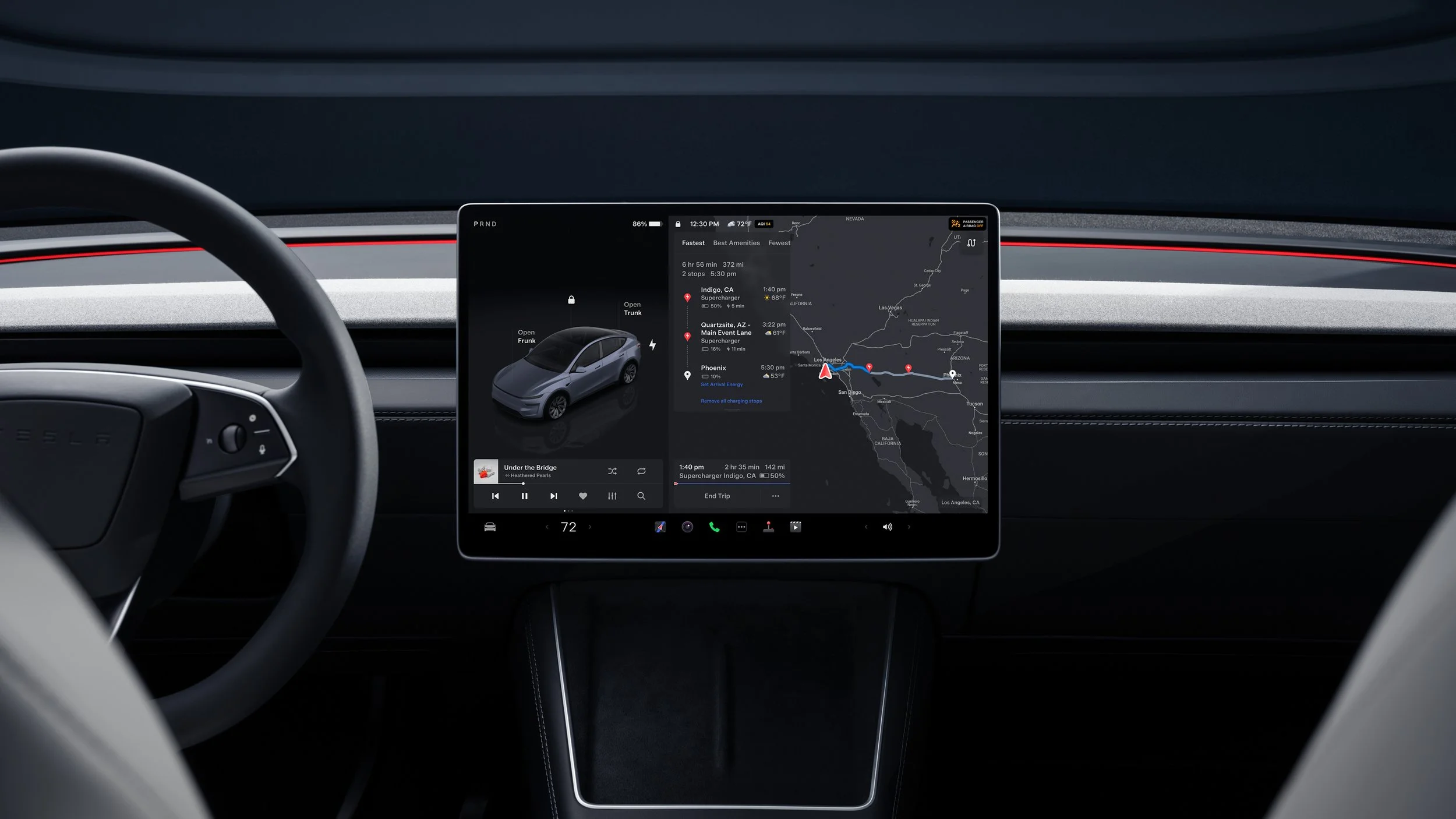
Software Defined Car Example
Connectivity
Connectivity is critical to a software defined car, because without it, over-the-air updates could not happen. It also serves as data logging for fleet learning, remote diagnostics by technicians and the cars self-diagnostic programs, as well as app integration that requires internet connectivity.
There’s also opportunity for manufacturers to monetize certain features to unlock more from the car should the customer require it, such as level 2 ADAS, or in-car entertainment for example.
There’s also the opportunity for remote over-the-air diagnosis by technicians when something has gone wrong, often being able to fix an issue and rollout a specific patch. Or following a remote diagnosis, they can even order new parts ensuring they’re ready for a visit to the service centre, or a ranger call out to fit the part.
Entertaining in the car with access to streaming services and social media platforms helps pass the time at the chargers, or keeps children occupied when waiting in the car.
It also allows for streaming music, podcasts, internet based radio stations and more.
Connectivity will also occur between the cars app and the car itself to pre-cool, or pre-heat the car, add a charging schedule, or a preconditioning schedule, send it a new destination, or route plan, or use its tracking device if you have lost it in a car park, as I have done.
Conclusion
The advantage with computing platforms first, allows for a continuous evolution of a customers car, improving over time, ironing out issues and flaws, adding new features and enhancing existing features.
The car is no longer fixed with embedded hardware controls the moment it leaves the factory, remaining unchanged, or degraded the day it enters the scrap yard, because a software defined car will be significantly better - with more features and functions - on it’s last day on this planet vs its first day.
———
About the Author
Graeme Cobb is a lifelong car enthusiast with a passion for writing about cars, EVs, industry updates and more.
You can find Graeme on 𝕏 at @graeme_cobb or YouTube @REV-EV.