SMMT Reports Production Grows But Issues Persist
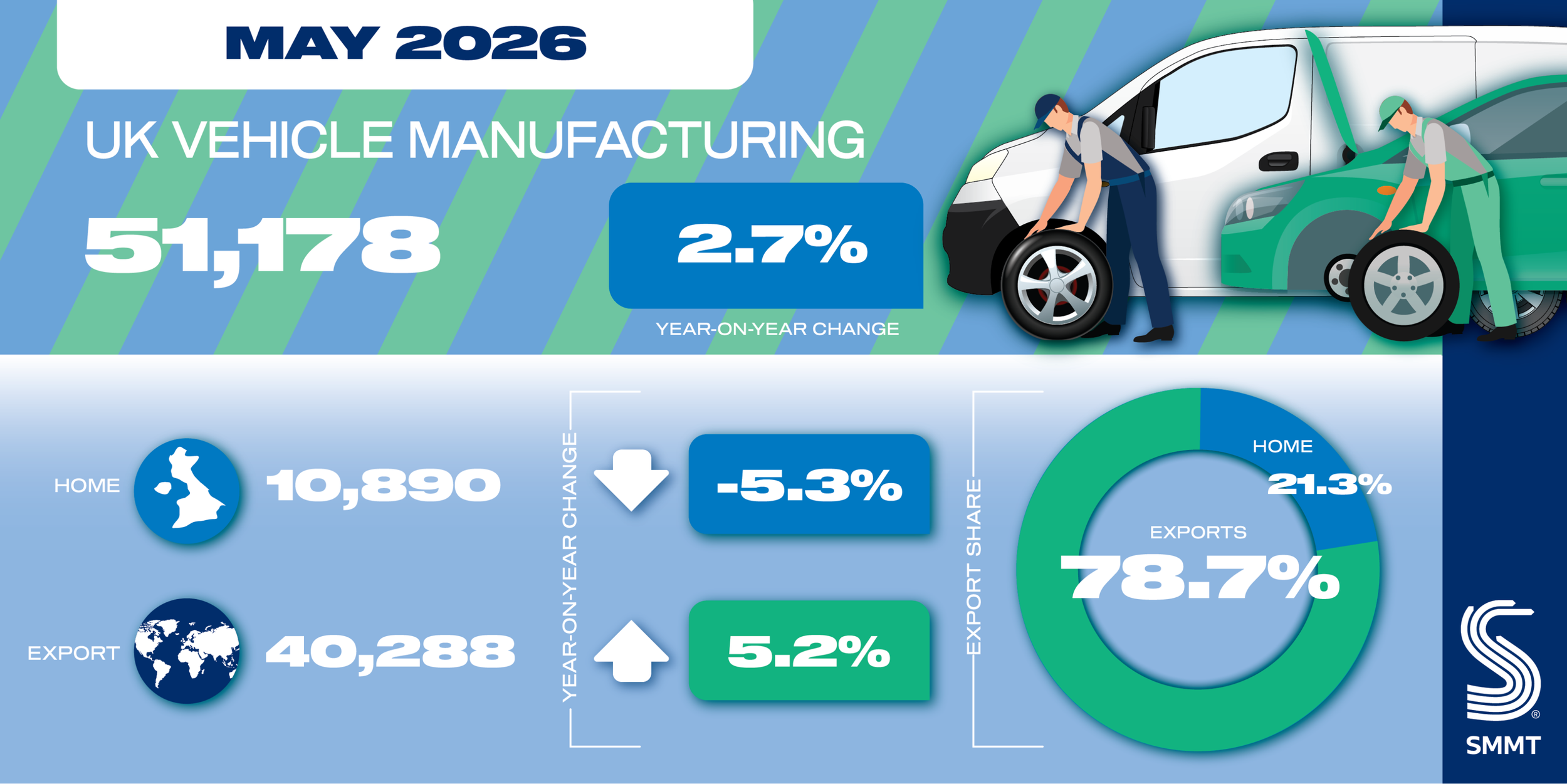
UK vehicle production rose 2.7% in May to 51,178 units, according to the latest figures published today by the Society of Motor Manufacturers and Traders (SMMT).
However, it was car output that grew the highest in May at 3.2% to 49,249 units when compared to last month, reversing four months of decline. However, it was not all welcome news as commercial vehicle (CV) production volumes fell -7.6% to 1,929 units.
Some may attribute the stronger performance to an increase in demand for electric Vehicles, but the SMMT’s analysis claims it was driven by overseas orders. It reflects a significant recovery since May 2025 when production showed a significant -30.3% decline. This was caused by an anomaly following uncertainty around US tariff hikes, knocking confidence to it’s lowest level since Covid hit in 2020.
Exports
The increase in production reflects car exports that rose 3.9% to 38,897 units, while Commercial Vehicle exports increased 61.0% to 1,391 units. The combined export reflects a 5.2% increase in overseas trade.
Top car export markets were the United States as the strongest performer, with shipments up 83.1% to 7,733 units. This is reflective of a new US-UK trade deal that took effect from June 2025.
However, exports to the EU fell -5.2% to 20,057 units, while those to China were down -14.3% to 2,794 units.
Exports account for 76.4% of all vehicle production so far this year, with almost a quarter of a million (242,792) units shipped overseas.
Domestic
The domestic car market was relatively flat, up by 0.7% to 10,352 units, while Commercial Vehicle output for UK buyers fell by a significant -56.0% to 538 units.
Manufacturing
Year-on-Year UK factory production looks more bleak as it fell to 317,779 vehicles, down -8.7%, with car production declining by -4.1% and Commercial Vehicle production falling by -60.0%.
With high energy costs, uncertainty with EU trade barriers looming and a flat domestic market, plus the Middle East conflict knocking confidence, recovery will take time, despite the welcome recent progress.
Mike Hawes, SMMT Chief Executive, said, “May’s growth is welcome, and the priority must be to turn this into a sustained recovery by making the UK more competitive as a place to make and sell vehicles. That means reducing industrial costs, maintaining free and open trade with the EU, and ensuring the ZEV mandate reflects market reality. Manufacturers are investing billions in zero emission technology, but weak underlying demand and the growing cost of compliance are putting competitiveness, jobs and future investment at risk. A mandate aligned with real-word conditions would support decarbonisation, strengthen the market, and help unlock the investment needed for long-term economic growth.”
———
About the Author
Graeme Cobb is a lifelong car enthusiast with a passion for writing about cars, EVs, industry updates and more.
You can find Graeme on 𝕏 at @graeme_cobb