
Kia PV7 Cargo and Passenger: Kia’s electric van gets bigger
The Kia PV5 has delivered superb results for the Korean giant’s first foray into commercial vehicles. Kia is expanding its electric commercial vehicle range with the new PV7, a larger and more versatile sibling to the PV5; now Kia is looking to build on that success.
Available as both a Cargo van and Passenger people carrier, the new PV7 is designed to cover everything from logistics and fleet work to shuttle services and family transport.
This second model in Kia’s dedicated Platform Beyond Vehicle (PBV) range, and while the PV5 is focused more heavily on urban flexibility, the PV7 has been developed as a larger, more capable business tool with greater capacity and a much wider range of applications.
Designed as a business tool
Kia says its development of the PV7 began by identifying some of the biggest problems facing commercial vehicle operators. Simply replacing a conventional diesel van with an electric one isn't necessarily enough, with issues including inefficient working practices, disconnected workflows, the challenges of electrification and unpredictable maintenance potentially affecting productivity. The PV7 is therefore designed with these problems in mind and aims to take them with hardware, software and service; keeping vehicle uptime high on the priority list.
At its heart is Kia's dedicated E-GMP.S architecture. The PV7 will be offered with 71.5kWh and 96.2kWh NCM battery options, with up to 200kW and 420Nm available. Front-wheel drive is standard, while an all-wheel-drive version is planned for the future. The Long Range Cargo is claimed to offer more than 460km, or around 285 miles, of WLTP range. Its 800-volt electrical architecture also allows Kia to claim a 10-to-80% charge in the mid-20-minute range using a 350kW DC charger, with the final figure to be confirmed.
Its flat-floor design maximises interior space while allowing the PV7 to be adapted into different body styles and configurations.
Kia PV7 Cargo
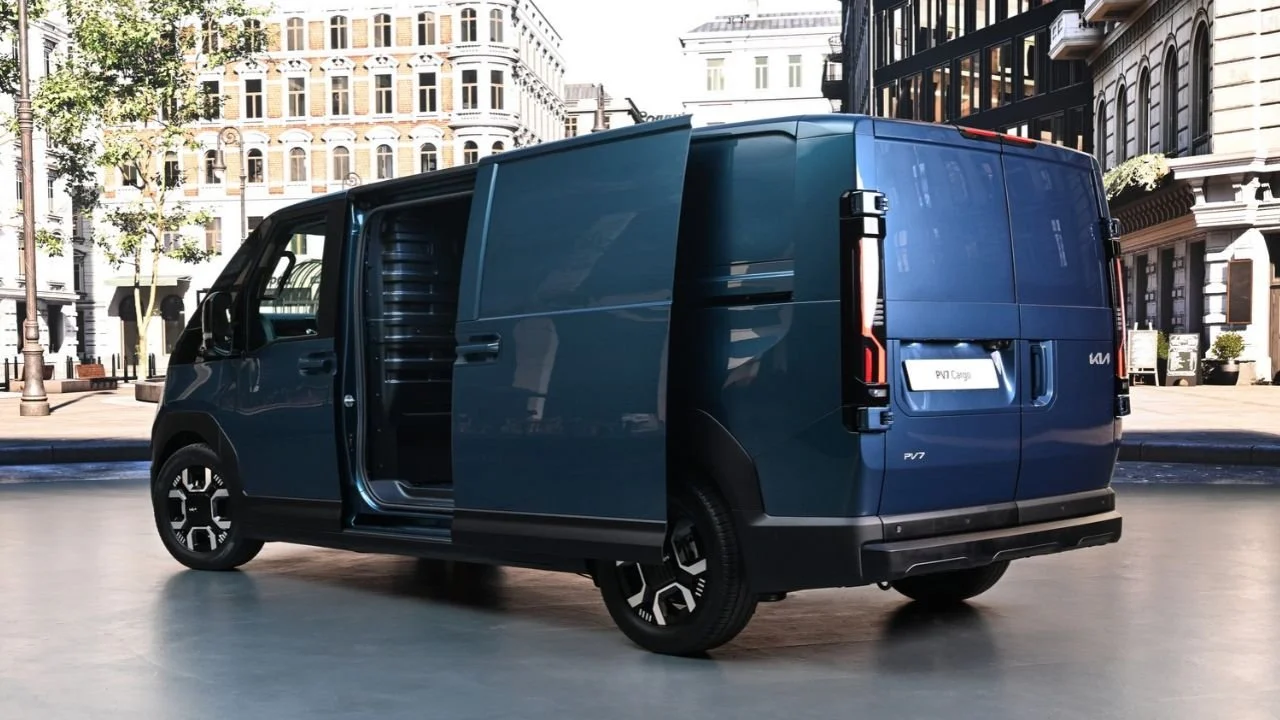
The PV7 Cargo is aimed at logistics, deliveries, fleets and small and medium-sized businesses. The important numbers, however, are in the load area.
The PV7 Cargo Long provides up to 6.1 cubic metres of cargo space, enough for three Euro pallets, with a maximum payload of up to 1,165kg and a 550mm loading height. It's big enough to take three Euro pallets, and while Kia hasn't yet confirmed the final load-floor dimensions, the PV7 should also be well suited to carrying standard 8x4 sheet materials.
The High Roof increases cargo capacity to as much as 8.0 cubic metres, while the Compact version can carry up to 1,200kg. Kia has also concentrated on everyday usability, with twin-swing or lift-up tailgate options, a load-through bulkhead, independent cargo-door locking, remote cargo-door status monitoring and Smart Walk Away, which can automatically close the power sliding door when the driver leaves with the smart key.
A dedicated heavy-load driving mode is designed to adapt the vehicle's performance according to its payload, while the Cargo's "Mobile Workspace" interior adds open storage and, on three-seat models, a folding centre seatback that creates an additional tray.
The idea is to make the PV7 useful even when parked, while Kia's Business Solutions Portal brings together fleet management, charging, maintenance and operational information. Its Uptime services use real-time monitoring and predictive diagnostics to help identify potential issues and reduce unexpected downtime, somethign that could prove valuable for business owners.
Kia PV7 Passenger
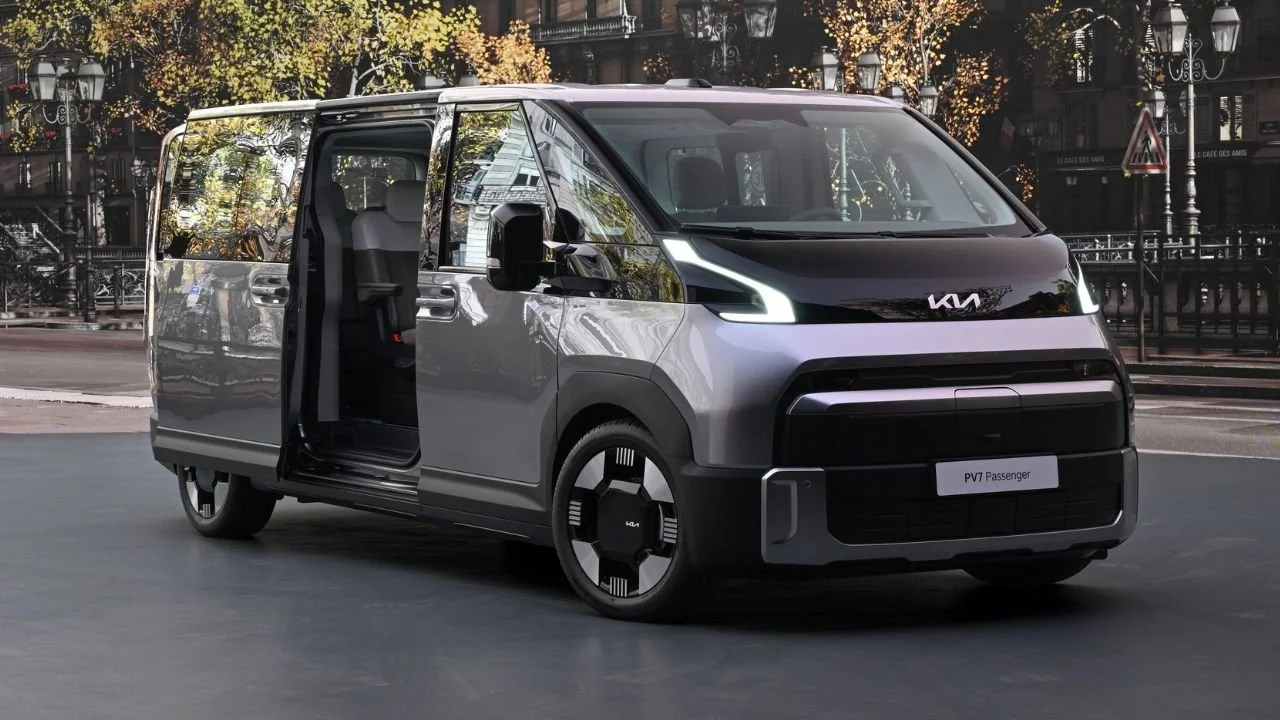
The PV7 Passenger takes the same basic electric platform and turns it into a large, flexible people carrier. It can accommodate up to nine occupants, with different seating configurations aimed at crew transport, shuttle services, rental, tourism and family use. The seven-seat model uses Long-Rail Easy Remove Seats, allowing the cabin to be reconfigured, while the nine-seat version can be specified with or without a fourth row.
Comfort is a bigger priority here, with rear climate control, available 100W USB-C charging, additional storage and power sliding doors. Kia has also given the Passenger a more sophisticated, lounge-inspired interior with two-tone finishes, enclosed storage, optional ambient lighting and an optional centre console that doubles as a table.
Like the Cargo, the PV7 Passenger has been designed around the people using it every day, with features including an A-pillar grab handle and revised step geometry intended to make frequent entry and exit easier.
Technology and the bigger picture
Both versions use Kia's Pleos Connect system, based on Android Automotive OS, providing connected navigation, flexible screen layouts, an app marketplace and over-the-air updates. There's also Gleo AI, Kia's AI-powered voice assistant, while Vehicle-to-Load capability allows the PV7 to provide power to tools, equipment and other devices through interior and exterior outlets.
The wider PBV strategy is arguably just as important as the vehicle itself. Kia plans to expand the PV7 range to 23 variants, including Cargo Compact, Long and High Roof models, Passenger Compact and Long versions, a Chassis Cab and numerous conversion models. Production and conversion will be supported by Kia's Hwaseong EVO West PBV Plant and dedicated PBV Conversion Centre, alongside regional conversion partners.
More to come…
The PV7 is only the next step, too, with Kia planning to introduce the larger PV9 in 2029. The PV7 Cargo and Passenger are due to launch in Korea and Europe in the second half of 2027, although UK pricing, specifications and equipment have yet to be confirmed and may vary from other European markets.
The Kia PV5 was one of my 2025 ‘vehicles of the year’, the PV7 now looks to add more flexibility and new options for this pioneering electric LCV range. The PV7 represents considerably more than simply a larger electric van, or just an attempt to convert business from Diesel to EV. Despite a little of the usual marketing fluff, this seems like a very well-developed and genuine attempt to rethink the commercial vehicle around the needs of modern businesses.
Stay tuned for more news as we get it. In the meantime, check out our video preview (below), and don’t forget to look for the latest lease prices for commercial vehicles over at Leasing.com