EV New Car Registrations Surge in July but Falls Short of ZEV Mandate Target
The July 2026 new car registration data is in and the EV market continues to surge amidst the ongoing high fuel prices caused by the Middle East conflict.
Overall, the July new car market has risen by 11.7% to 156,571 units indicating it’s best performance since 2019, according to the Society of Motor Manufacturers and Traders (SMMT).
New Vehicle Registrations
Battery Electric Vehicle registrations climbed 44.5% compared to July 2025, now commanding 27.5% market share, driven by the Electric Car Grant, favourable BiK rates, industry discounts, more EV choice coming to market and the high fuel prices seen on the forecourts.
It’s no coincidence then that diesel registrations fell 17.7% and petrol registrations fell 5.2% in the same period, taking a 4.2% market share and 40.1% market share respectively. Combined, petrol and diesel account for 44.3% market share, and that number continues to trend downward throughout 2026.
Hybrid and Plug-in Hybrid registrations continue a steady growth pattern, and although hybrid market share remains the same, volumes sold has grown. Plug-in Hybrids have increased their market share from 12.5% in July 2025 to 14.9% last month, which is a noteworthy change of 33.6% year over year.
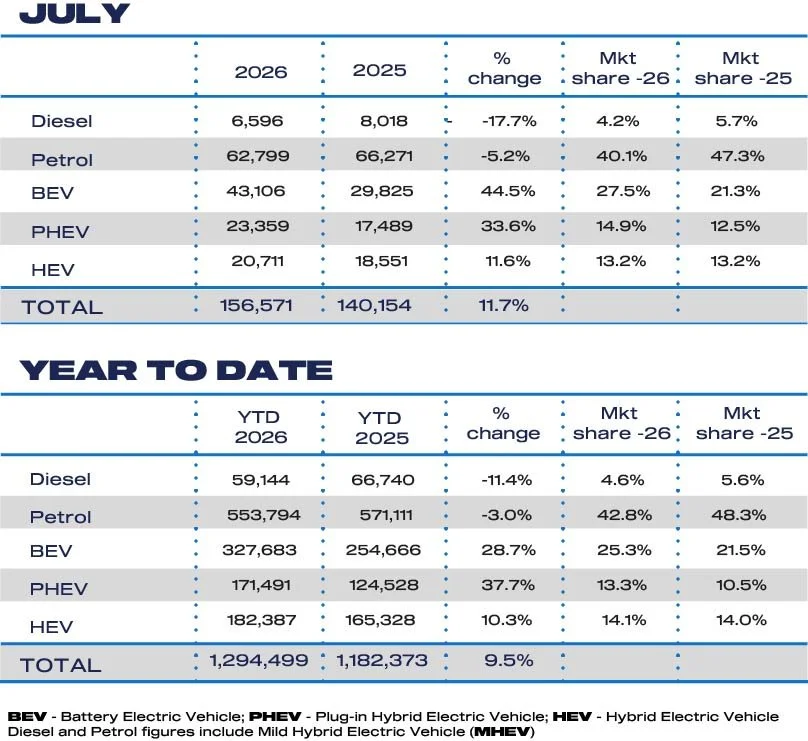
SMMT New Vehicle Registrations July 2026
Outlook
The industry now expects BEVs to reach 27.4% market share from a volume of 2.18 million cars produced in 2026, up slightly from April’s forecast of 26.8 % market share. However, this number is still significantly short of the 33% ZEV mandate target for 2026, but this target is not fixed because of the flexibilities written into the mandate, and it’s these flexibilities that may be pushing plug-in hybrids forward.
Battery electric vehicles are expected to account for 32.1% market share in 2027, with the target set at 38%. More new brands and new models will come to market in 2027 offering more choice, especially in the lower cost A and B segments that offers greater growth opportunity. And if fuel prices remain high throughout 2026, this could trigger a next wave of plug-in hybrid and battery electric car demand.
Sectors
Between Private, Fleet and Business, demand grew for each sector, with private buyer uptake rising 12.6% to take 37.1% market share in July. Year-to-date, and that number is 39.3%.
Fleet deliveries grew a more modest 9.5% taking 59.9% of all registrations, but that accounts for a slight fall in market share from 61.1% a year ago.
Lastly, business market share had a staggering growth spurt of 61.3%, and their market share increased from 2.1% to 3.0 %.
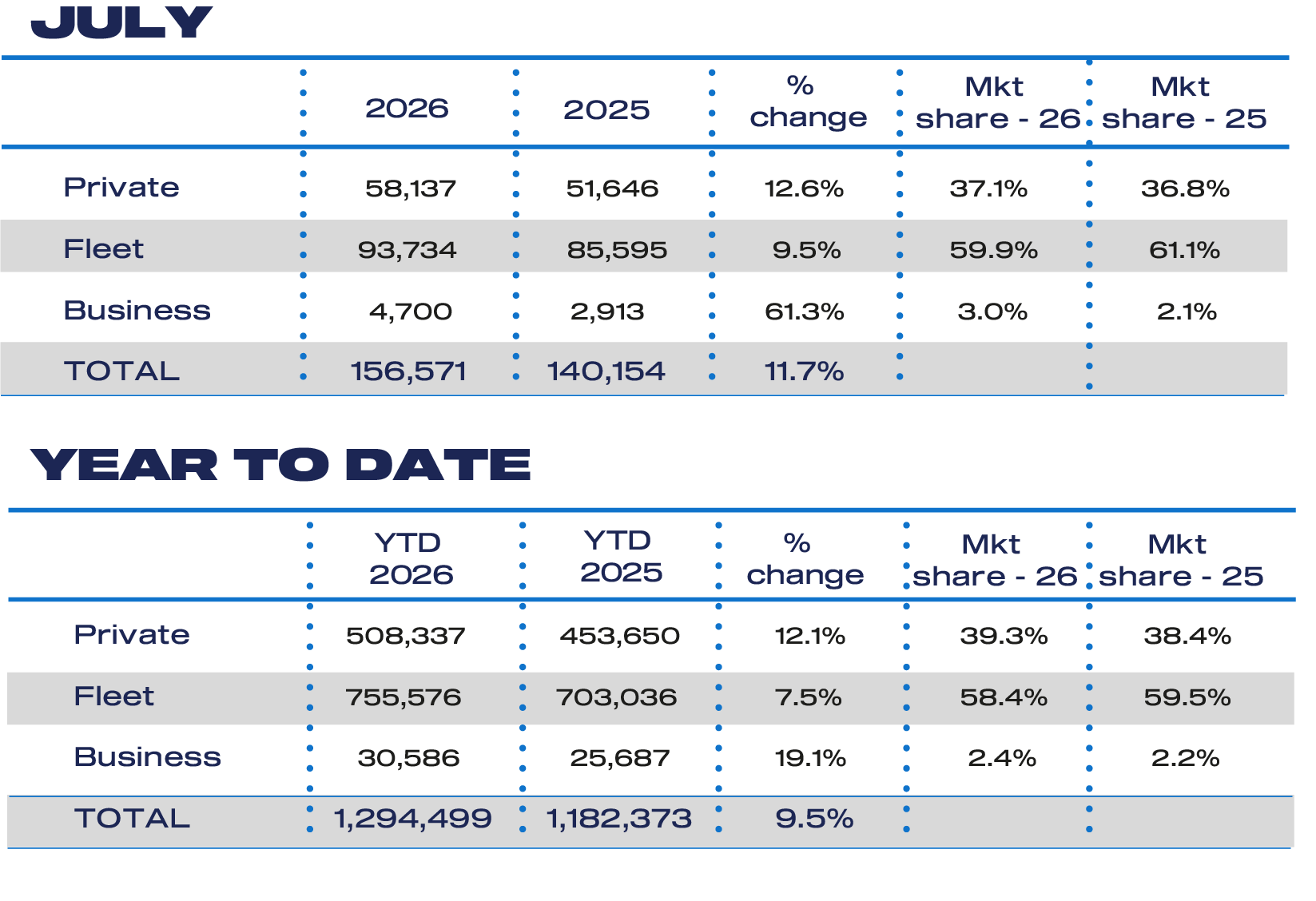
SMMT Sectors
Mike Hawes, SMMT Chief Executive, said, “July’s record EV performance is a great achievement, reflecting industry’s huge investment in zero emission mobility. But that progress cannot be sustained if manufacturers continue haemorrhaging billions in EV discounts, distorting demand to avoid even steeper penalties. The sector’s commitment to decarbonisation is not in doubt but its ability to remain viable – and attract investment for an EV future – is under intense pressure. A sustainable transition will not happen merely by compelling supply when underlying demand is not keeping pace despite year-on-year growth. We need urgent reform of the regulation, else Britain risks undermining its competitiveness and the jobs and livelihoods that depend on this industry.”
Winners
Although this is not broken down by fuel type, and some models have a blend of petrol, hybrid, PHEV and BEV, the Ford Puma wins it’s crown back once more as Britain’s favourite car. The Nissan Qashqai - perhaps Britain’s favourite family car - takes second spot with the Kia Sportage in 3rd and the Jaecoo 7 in 4th place.
Jaecoo also features twice in the top ten with the Jaecoo 5 taking up 7th spot. And year-to-date numbers show the Jaecoo 7 is the 3rd most favourite car in 2026, pushing the Nissan Qashqai back to 4th spot.
What this does show is the desire for SUV’s and crossovers all featuring in the top seven positions in July ‘26, with smaller hatchbacks relegated down the list in eight, ninth and tenth spot.
And year-to-date, SUV’s and crossovers represent seven out of ten mewly registered cars since the start of the year.
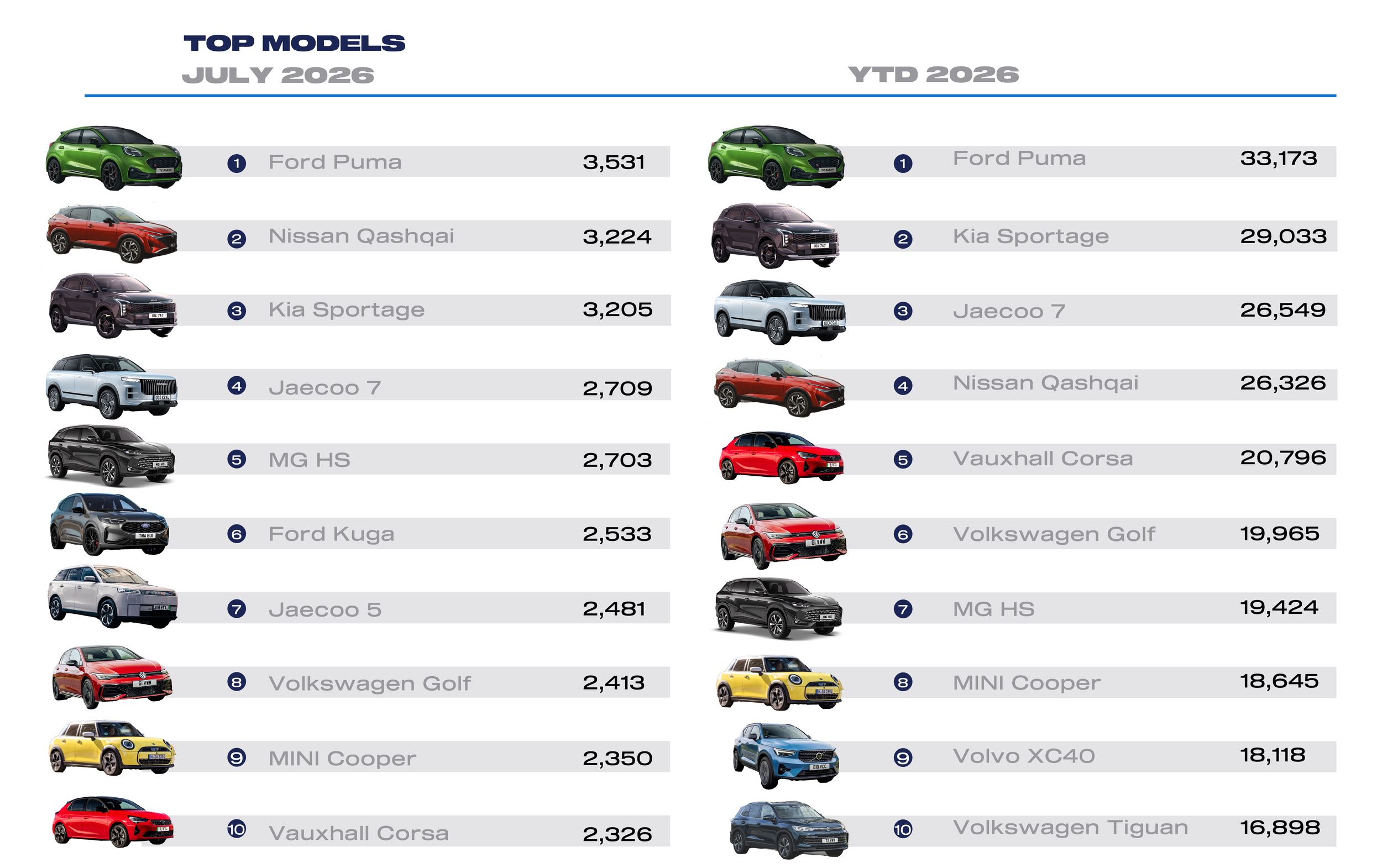
SMMT Top 10 Cars in July 2026 and Year-to-Date
For Battery Electric Vehicles, the SMMT has provided a top-ten, which I think is the first time they have produced this data.
Most would expect Tesla to feature in the top ten, and whilst they continue to do battle with BYD for overall annual EV sales, high demand, and manufacturing constraints is causing them to pop up and surprise one month and disappear the next in a ‘rinse and repeat’ fashion.
However, the excellent Renault 5 takes the top spot in July, with the KIA EV3 proving popular and the Jaecoo 5 - with its very desirable price and big spec - takes 3rd place.
At the expensive end, Mercedes and Audi feature in the top ten, proving that if they build great EVs, customer orders will follow.
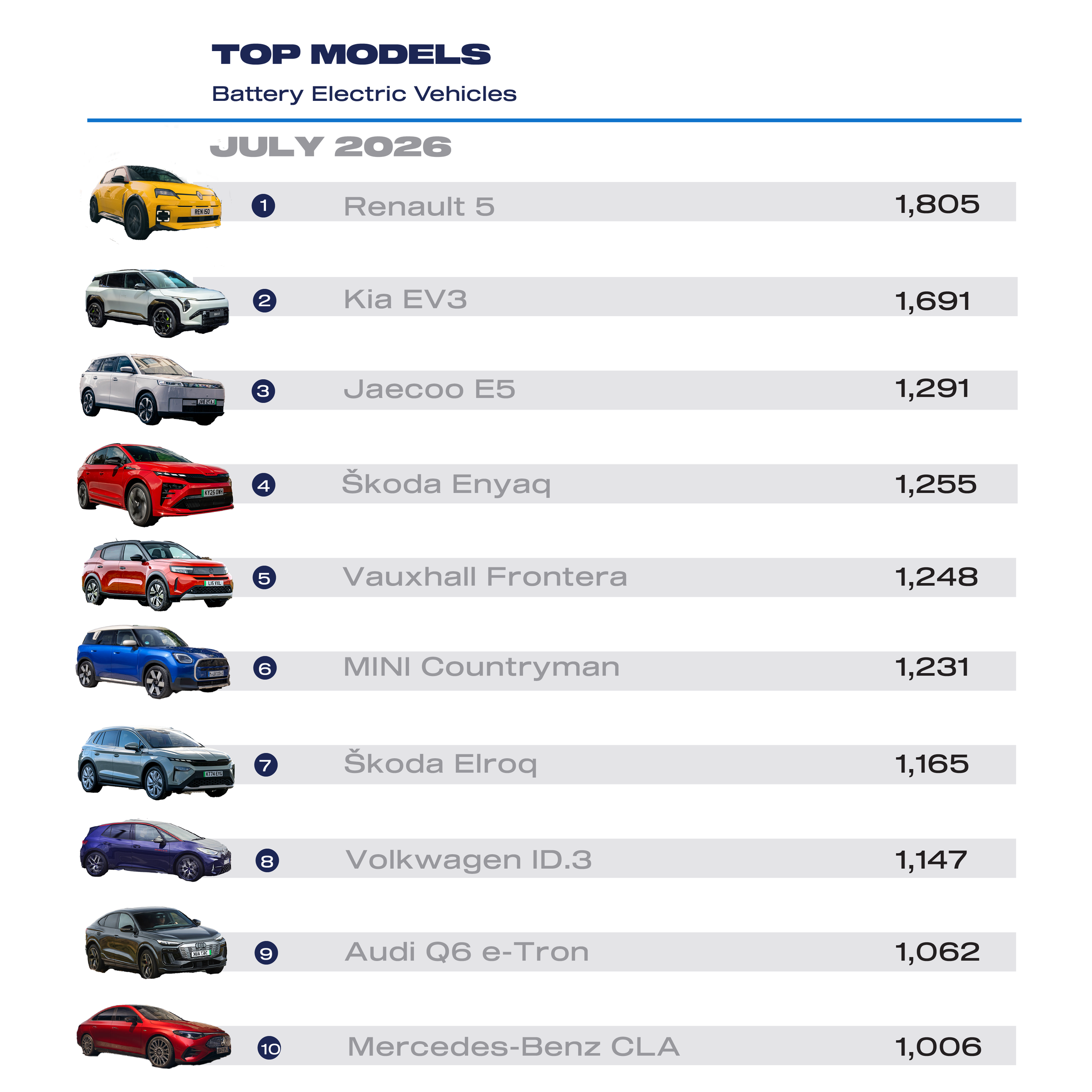
SMMT Top Ten BEV Registrations July 2026
Industry Update
Looking at July over the prior years, 2026 is becoming a turnaround year for the industry, breaking a trend of lower volumes. And this is despite the turbulence in the automotive industry from high fuel prices, high energy prices, increased food costs that seemingly have an upward trajectory from one month to the next hitting people’s purses and wallets hard.
The surprising element comes from an increase in private buyers, too, taking a near 40% market share this year so far, with business owners now buying more, too. But with the fuel mix continuing to change with the big movers from battery electric vehicles, and plug-in hybrid vehicles, perhaps customers are looking to save on fuel costs, and sentiment seems to be shifting that way, at least, especially as prices are becoming very close to price parity with the internal combustion engine.
However, the SMMT makes a very valid point, given their access to the data: “The outlook reflects manufacturer views submitted prior to the end of ECG eligibility for demonstrator and courtesy cars in mid-July. Given these vehicles currently account for around 10% of BEV registrations, and around a third of the BEV market is delivered through the ECG, the change could impact future performance.”
The SMMT also noted that “some buyers delayed switching until confirmation of full model eligibility for the Electric Car Grant (ECG).”
The Electric Car Grant requires manufacturers to submit complex applications that demonstrate their worthiness for eligibility based on location of battery cell manufacturing, clean energy use credentials, retail price plus many more metrics.
Manufacturers must submit applications and, when reviewed and approved, only then can their cars accrue the ECG. Previous schemes offered a blanket discount from the outset meaning less complexity, no time lag from application to approval and a very clear scheme applied to all electric cars.
Under the current ECG, customers may be putting off purchases for fear they may lose out on getting a discounted car.
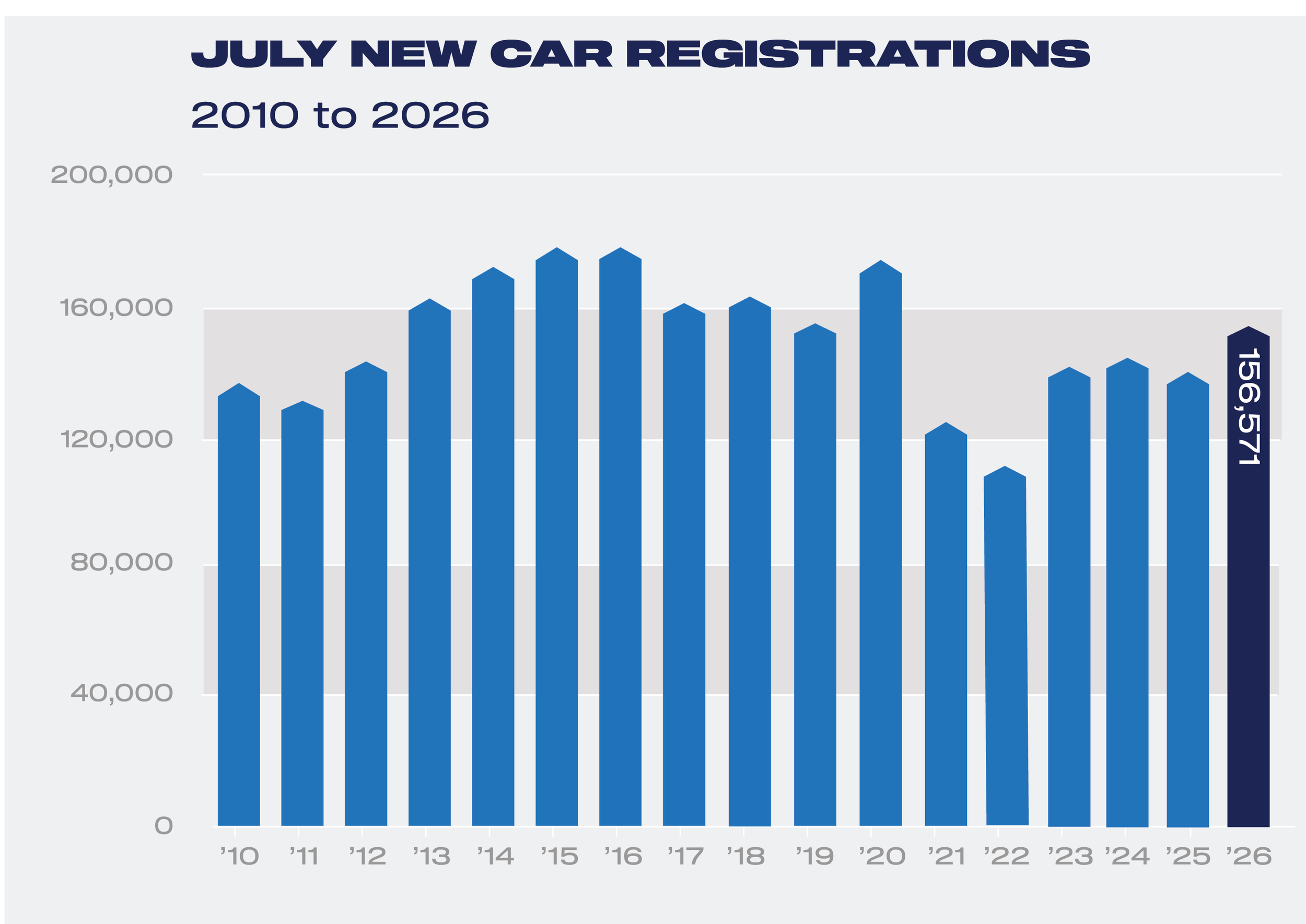
SMMT New Car Registrations Since 2010
Thoughts
Whilst the news is good for electric and electrified vehicles, it isn’t good for the internal combustion engine. And this means it’s hard for manufacturers to judge what to make and the volumes to make them in. They could have a perfectly good product, but if it’s not selling because sentiment has shifted as fuel prices have unexpectedly increased, manufacturers must find themselves in the difficult decision of prioritising volumes of certain fuel types over others, or be stuck with stock that sells slowly requiring a heavy discount for them to shift it.
Equally, the ZEV mandate requires manufacturers to ramp up EV production and sell it in every increasing volumes, but they are facing stiff competition from China who seemingly send us new brands frequently, at lower price points with a higher spec. And some manufacturers may turn a small profit or the have to absorb the cost, it cannot continue indefinitely. The cost wars have well and truly begun.
Manufacturers are faced with two choices; (1) develop their EVs to compete on cost, and that requires adapting new technologies, new manufacturing processes and new supply chains, or (2) consolidate. Consolidation may see manufacturing groups selling off brands, or they may enter partnerships with other manufacturers to co-develop cars and share the costs. However, both of these take time, and time is not on their side.
———
About the Author
Graeme Cobb is a lifelong car enthusiast with a passion for writing about cars, EVs, industry updates and more.
You can find Graeme on 𝕏 at @graeme_cobb