
2026 Kia PV5 Passenger Review
The arrival of the Kia PV5 Passenger feels like a genuine shift in the electric car market. For too long, buyers wanting maximum space have been pushed towards expensive, lifestyle-focused options like the Volkswagen ID. Buzz, or large electric SUVs that don’t quite deliver the same level of practicality. Kia’s approach is refreshingly different. The PV5 Passenger focuses on usability, affordability, and everyday functionality, while still managing to feel modern and, importantly, desirable.
From a pricing perspective, the Kia PV5 Passenger undercuts much of the electric MPV market in the UK. The PV5 Passenger starts from £32,995 on the road (with a circa £3,000 uplift for the long-range version), positioning it as one of the most affordable fully electric people carriers currently available. Be sure to check the current lease prices on a PV5 Passenger over at Leasing.com.
Built on the proven E-GMP platform, the PV5 shares its core architecture with several of Kia’s latest EVs, giving it a strong technical base. But what really stands out is how confidently it leans into its MPV form. The upright, boxy design isn’t trying to mimic an SUV; instead, it embraces its purpose, and in doing so creates something that feels both distinctive and honest. Despite its van-like appearance, it’s surprisingly manageable on UK roads, with dimensions not far off a Tesla Model Y in terms of width and height.
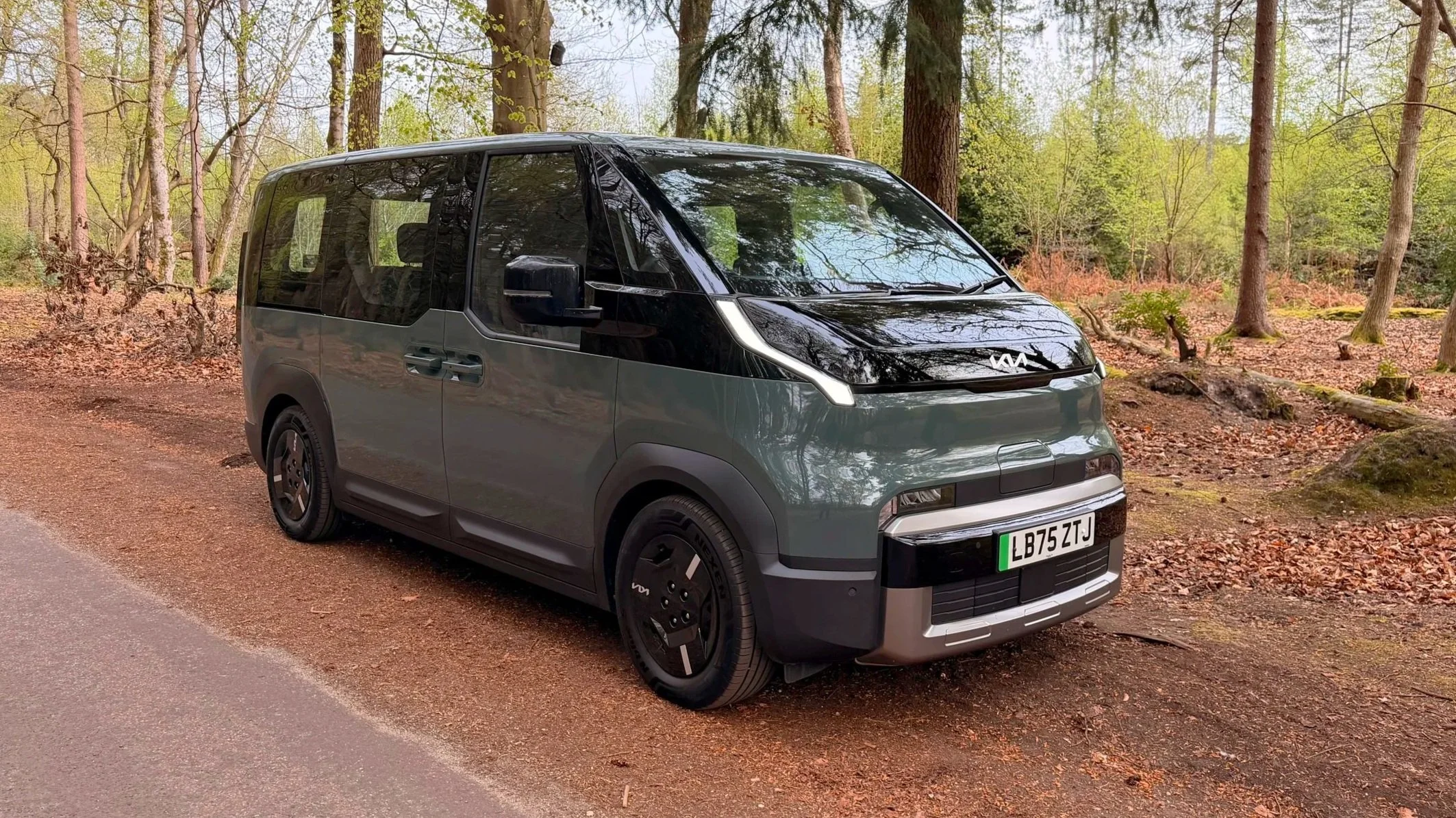
The design is utilitarian whilst also managing to have some serious cool factor - we love it!
Space, Practicality and Everyday Use
Inside, the PV5 Passenger is clearly designed around real-world use. There’s seating for five for now, with a seven-seat version due to arrive in 2026, and the rear seats recline to make longer journeys far more comfortable than you might expect from something in this class. It’s not perfect, folding the seats leaves a noticeable hump, and removing them entirely isn’t going to be straightforward, but for most buyers, the balance between passenger comfort and practicality will be more than sufficient.
Boot space is where it really excels. With around 1,330 litres available and a clever rail system built into the sides (which allows for various customisations), it offers genuine flexibility for everything from family luggage to work equipment. The tailgate is huge, making loading easy, although you’ll need to be mindful of size restrictions in tighter spaces as it can make it difficult to open.
Kia is also clearly thinking beyond the typical family buyer; we’re expecting to see a 7-seat version of the PV5 Passenger later in 2026 and, alongside the current Passenger & Cargo models, there are plans for a Combi, and even a wheelchair-accessible variant, reinforcing the PV5’s role as a genuinely multi-purpose vehicle.
Driving Experience and Performance
On the road, the Kia PV5 Passenger is genuinely difficult to fault. The driving position is superb, offering a commanding view of the road, while the seat and armrest are really comfortable; this kind of setup makes long journeys feel effortless rather than tiring. Visibility is another standout strength, helped significantly by the low side windows, which give a clear, open view that’s often missing in larger vehicles.
One of the more surprising highlights is the turning circle, which is excellent. For something that looks this square and substantial, it feels impressively manoeuvrable in tight urban environments, making parking and U-turns far less stressful than you might expect.
Out on the move, it delivers a smooth, predictable drive that suits its character perfectly. There is a little cabin noise from the suspension and some wind noise at higher speeds, but it never becomes intrusive or tiring; it’s noticeable rather than problematic.
In terms of performance, there are two battery options. The standard range model uses a 52 kWh NMC battery with 120 bhp, managing 0–62 mph in 12.8 seconds and offering a claimed 183 miles of range. The long-range version is the one most buyers will gravitate towards, pairing a 71.2 kWh battery with 161 bhp, reducing the 0–62 mph time to 10.7 seconds and increasing the WLTP range to 256 miles. Real-world motorway efficiency sits at around 3.1 miles per kWh, which is respectable for a vehicle of this size.
That said, range remains the one area where the PV5 feels slightly underwhelming. While perfectly usable, it doesn’t quite reach the 300-mile benchmark that many buyers are beginning to expect, particularly when rivals like the Peugeot e-5008 and the ID. Buzz are edging closer (or beyond) - albeit at significantly higher price points.
Charging is competitive, with up to 150 kW DC capability helping to keep longer journeys manageable, especially when combined with the car’s overall comfort and ease of use.
Equipment levels are strong throughout the range, with features such as adaptive cruise control, parking sensors, a reversing camera, and automatic lights and wipers included as standard. Moving up to the Plus trim, at around £38,000, adds a welcome layer of comfort and convenience, including electric and heated seats, a powered boot lid, and vehicle-to-load functionality on the larger battery.
Verdict
The Kia PV5 Passenger succeeds because it focuses on what actually matters. It’s spacious, comfortable, easy to drive, and priced in a way that makes it genuinely accessible. While it may not quite match the polish of the Volkswagen ID. Buzz, it gets remarkably close in everyday use — and does so for tens of thousands of pounds less.
Add in its versatility, strong equipment levels, and the fact that it’s a vehicle people are genuinely curious about, and you end up with something quite rare: an MPV that feels cool again.
The only real drawback is the range, which could be stronger to truly future-proof it against emerging rivals. But taken as a complete package, the PV5 Passenger feels like one of the smartest and most likeable electric family vehicles currently available in the UK.
If you’re considering a new car, it’s worth seeing what’s actually available in the real world rather than just looking at list prices, so check current deals here: Leasing.com