The Volkswagen Golf and New T-Roc get a Full Hybrid Option
If, like me, you find too much choice confusing, then Volkswagen has made picking a new Golf or T-Roc that little bit more tricky.
Along with the petrol, diesel, mild hybrid, and plug-in hybrid powertrains, there is now a new full hybrid. Toyota calls it a self-charging hybrid, which invariably requires petrol to power it, but it means there is no plugging in to do, whilst it returns great efficiency.
And Volkswagen is directly challenging master hybrid makers - Toyota - with its popular Golf and T-Roc hybrids by mating its 1.5 TSi turbocharged petrol engine with two electric motors and the high-voltage battery to achieve great efficiency.
The main difference between the mild hybrid - which has a 48v, low voltage battery (approximately 0.6 kWh) - is that the full “self-charging” hybrid has a 1.6 kWh NMC Lithium Ion high-voltage battery integrated into the vehicle floor at the rear of both the Golf and the T-Roc.
The full hybrid system will provide a reasonable amount of low speed electric driving which significantly cuts fuel consumption and emissions. Volkswagen have yet to verify exact MPG figures - that will come later - but expect mid-to-high 50’s, possibly even 60 mpg as a guestimate for now.
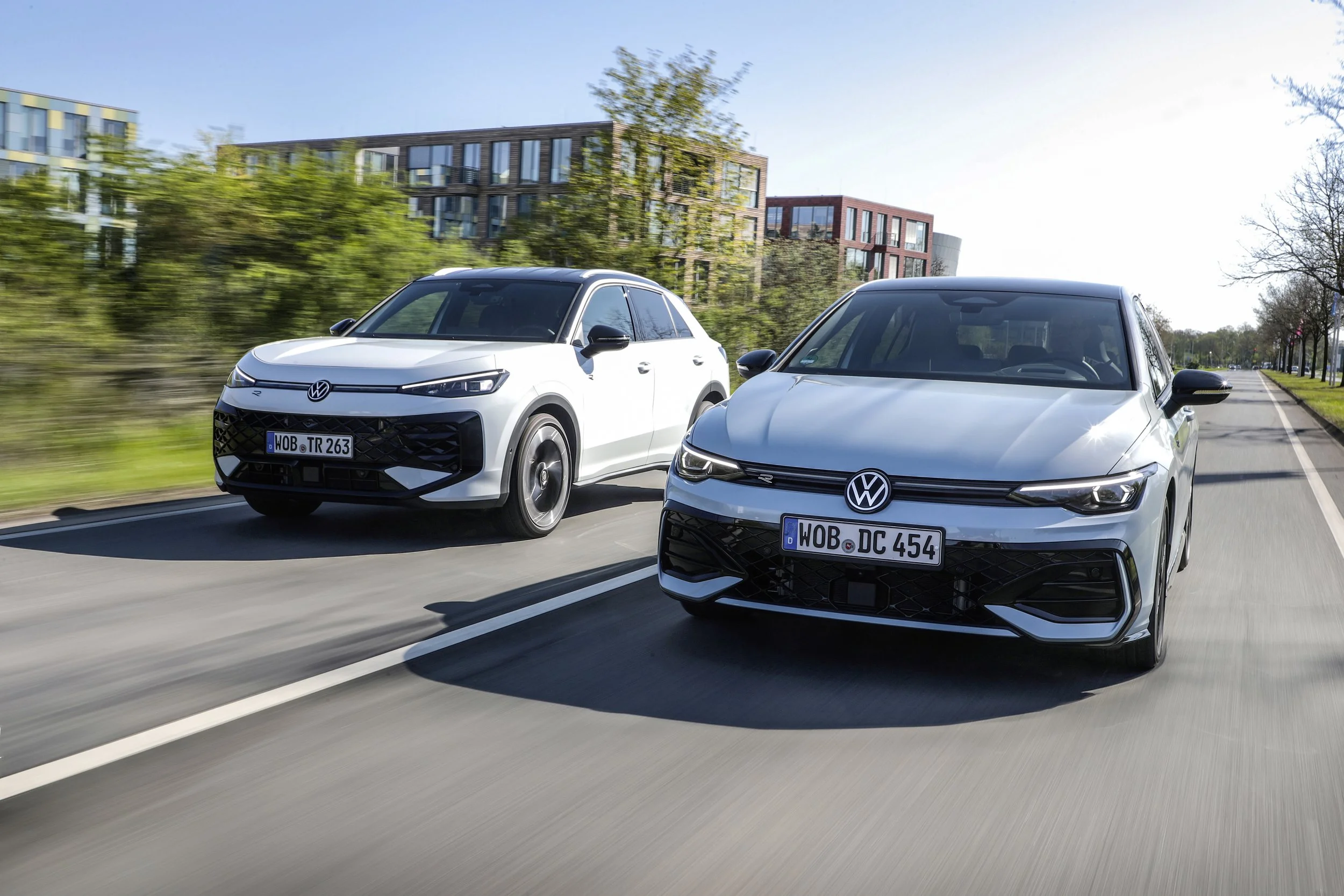
The new T-Roc and Golf Hybrid’s with a ‘R’ on the front
Volkswagen says “the drive system offers three operating modes that are automatically activated by the vehicle depending on the usage profile:
Propulsion by electric motor – driving at low speeds powered using the electric motor alone, the TSI is switched off.
Serial drive – electric motor plus generator: driving with electric motor. The TSI is active but decoupled to generate energy for the electric motor via a generator in an optimal operating window and thus extend the electric range.
Parallel drive – petrol engine and electric motor – the TSI is active as the primary drive system from around 60 km/h on country roads and motorways; the electric motor supports the turbocharged engine, for example, as a booster when accelerating.”
In addition to the operating modes, the driver can select three driving profiles: Eco, Comfort and Sport.
In Eco mode the power output is limited to 70 per cent with the turbo’s boost function deactivated to reduce fuel consumption.
Comfort mode provides full power and allows the turbo to boost up, so this will be the most natural setting out of the three.
Sport mode driving characteristics are achieved by the drive changing earlier to serial mode so that full power is made available quickly, reducing the cars efficiency.
UK specification, pricing and availability of these models will be confirmed soon.
———
About the Author
Graeme Cobb is a lifelong car enthusiast with a passion for writing about cars, EVs, industry updates and more.
You can find Graeme on 𝕏 at @graeme_cobb or YouTube @REV-EV.